
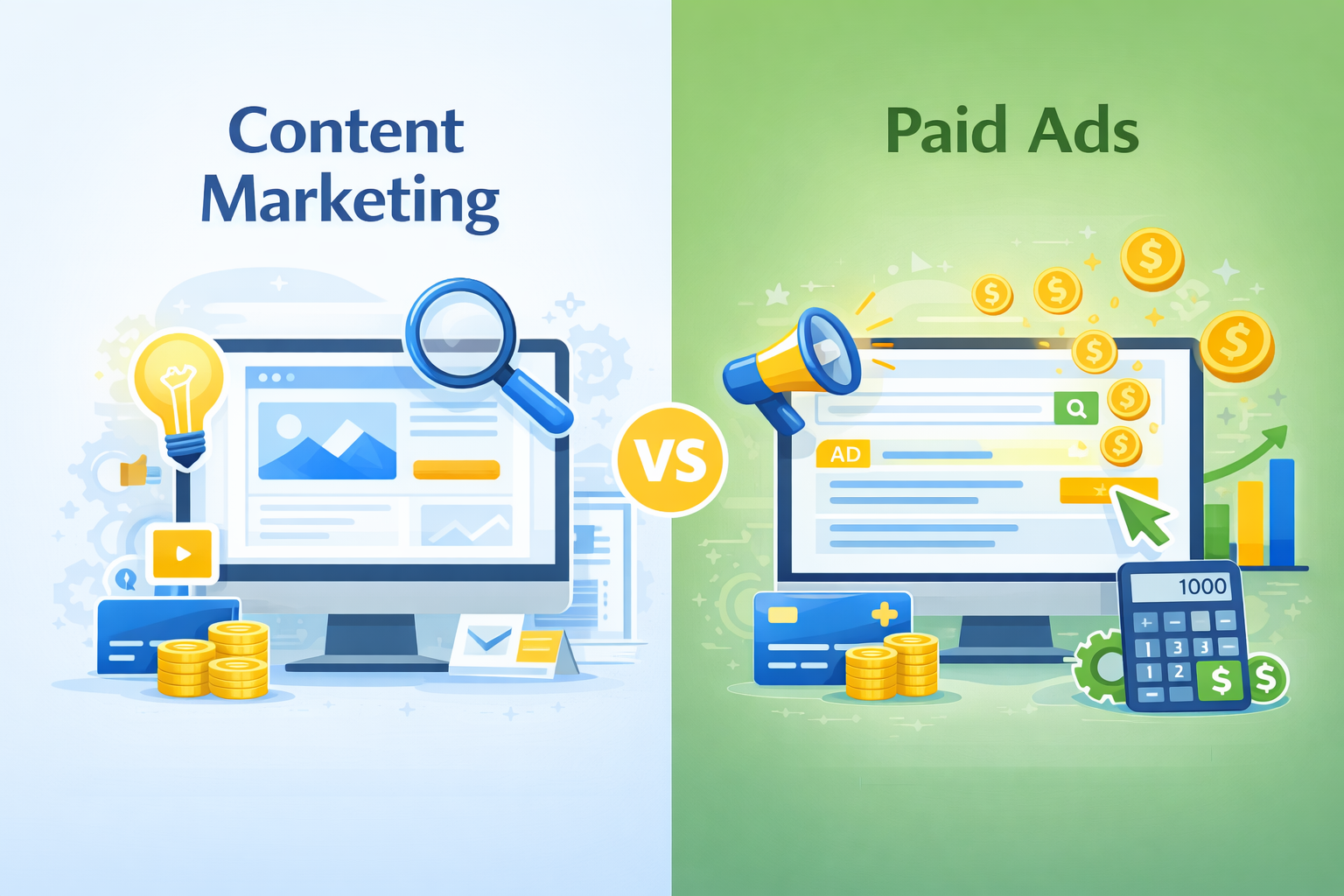
Content Marketing vs. Paid Ads: What’s More Cost Effective?
Content marketing focuses on creating long-term assets like blog posts, videos, and guides that attract organic traffic over time, while paid ads generate immediate visibility by paying for placement in search engines or social platforms. Content compounds in value, whereas ads stop performing once spending stops.
Most businesses begin seeing measurable results from content marketing within 3–6 months. Over time, high-quality content can drive consistent traffic, improve SEO rankings, and lower customer acquisition costs.
Yes. Paid ads are one of the fastest ways to generate leads because they target users who already have high purchase intent. However, they require continuous budget investment and careful optimization to remain profitable.
Every business eventually asks the same question when planning its marketing budget:
Should we invest in content marketing, or should we put our money into paid ads?
It’s a fair question and also a critical one.

Both content marketing and paid advertising can drive leads, traffic, and revenue. But they operate on very different economic models, timelines, and risk profiles. One compounds over time. The other delivers speed at a price. One builds long-term authority. The other rents attention.
Understanding which strategy is more cost effective isn’t about choosing sides — it’s about understanding how each channel works, what it costs over time, and how it fits into your business goals.
In this guide, we’ll break down content marketing vs. paid ads through the lens of:
- Cost
- Return on investment (ROI)
- Time to results
- Scalability
- Trust and buyer behavior
- Long-term sustainability
By the end, you’ll have a clear framework to decide which strategy — or combination — makes the most financial sense for your business.
Understanding Cost Effectiveness in Marketing

Before comparing channels, we need to define what “cost effective” actually means in marketing.
Cost effectiveness is not just about:
- Lowest upfront spend
- Cheapest cost per click
- Short-term results
True cost effectiveness considers:
- Cost per acquisition over time
- Customer lifetime value
- Sustainability of traffic and leads
- Dependency on platforms
- Risk exposure
- Ability to compound results
A channel that looks expensive upfront may be far more profitable long term. Meanwhile, a channel that looks “cheap” can quietly become a never-ending expense.
This is why businesses that chase short-term wins often struggle with long-term growth — and why businesses that invest strategically outperform competitors over time.
What Is Content Marketing?


Content marketing is the practice of creating valuable, relevant, and educational content designed to attract, engage, and convert a specific audience.
This includes:
- Blog articles
- SEO-driven landing pages
- Guides and whitepapers
- Videos and YouTube content
- Case studies
- Email newsletters
- Social media content
Unlike paid ads, content marketing does not rely on paying for each impression or click. Instead, it focuses on earning attention through relevance, authority, and trust
How Content Marketing Works Economically?
Content marketing follows a front-loaded investment model.
You invest time and resources upfront to create content. Over time, that content:
- Ranks in search engines
- Gets indexed by AI systems
- Builds authority
- Drives recurring traffic
- Generates leads without incremental cost per click
This creates a compounding effect.
A well-written article published today can still generate traffic, leads, and revenue years later — without additional spend.
What Are Paid Ads?
Paid advertising includes any channel where visibility is purchased directly.
Common paid ad platforms include:
- Google Search Ads
- Google Local Services Ads
- Google Maps Ads
- Meta (Facebook & Instagram)
- YouTube Ads
- TikTok Ads
- LinkedIn Ads
Paid ads operate on a pay-to-play model. You pay for:
- Clicks
- Impressions
- Conversions
- Calls
- Views
The moment you stop paying, visibility disappears.

How Paid Ads Work Economically?
Paid advertising follows a linear cost model.
Every result has a direct cost attached to it:
- More clicks = more spend
- More leads = higher budget
- More competition = higher costs
This makes paid ads predictable and scalable — but also increasingly expensive in competitive markets.
Upfront Costs — Content Marketing vs Paid Ads

Content Marketing Costs
Content marketing costs typically include:
- Strategy and planning
- Writing and content creation
- SEO optimization
- Design and visuals
- Distribution and promotion
- Ongoing updates
While content marketing often appears “free” on the surface, it requires:
- Skilled labor
- Time
- Consistency
However, once content is created, it does not require ongoing payment to continue generating results.
Paid Ads Costs
Paid ads costs include:
- Media spend (daily, weekly, monthly)
- Management fees
- Creative production
- Testing and optimization
- Rising auction prices
Paid ads require continuous funding. There is no residual value once spend stops.
This difference alone dramatically impacts long-term cost effectiveness.
Long-Term ROI — Compounding vs Continuous Spend
This is where the biggest gap appears.
Content Marketing ROI
Content marketing compounds.
Each piece of content:
- Builds authority
- Supports other content
- Improves domain trust
- Strengthens SEO signals
- Increases AI search visibility
Over time, cost per lead decreases while output increases.
Paid Ads ROI
Paid ads reset every day.
Even optimized campaigns face:
- Rising CPCs
- Increased competition
- Ad fatigue
- Platform dependency
Paid ads can be profitable — but they rarely become cheaper over time.
Immediate Wins vs Sustainable Growth
One of the biggest differences between content marketing and paid ads is how quickly results appear.
Paid ads are often appealing because they feel immediate. Launch a campaign today, and you can generate traffic and leads within hours. Content marketing, by contrast, requires patience. Articles take time to rank. Videos take time to gain traction. Authority takes time to build.
However, speed alone does not equal cost effectiveness.
Paid Ads and Short-Term Momentum
Paid ads excel when:
- A business needs leads immediately
- A promotion is time-sensitive
- A new product or service is launching
- Testing demand or messaging quickly
The challenge is that this momentum is rented. Once spend pauses, the pipeline shuts off. Businesses that rely exclusively on paid ads often find themselves stuck on a treadmill — always spending just to maintain baseline visibility.
Content Marketing and Long-Term Stability
Content marketing trades speed for durability.
Once content gains traction:
- Traffic becomes consistent
- Leads arrive without incremental spend
- Brand recognition compounds
- Results persist during slow seasons or budget changes
From a cost perspective, this stability reduces volatility and risk. Businesses with strong content foundations are less exposed to ad platform changes, auction inflation, and economic shifts.

Trust, Authority, and Buyer Psychology
Cost effectiveness isn’t just about numbers — it’s also about how buyers think and behave.
Modern consumers are skeptical. They know ads are paid placements. They actively seek validation before making decisions, especially for high-consideration purchases.
Why Content Builds Trust
Content marketing positions a business as a guide, not a salesperson.
Educational content:
- Answers questions buyers are already asking
- Demonstrates expertise without pressure
- Builds familiarity before contact
- Reduces friction in the sales process
When a prospect arrives via content, they are often warmer, more informed, and more confident in their decision.
Why Ads Face Trust Barriers
Paid ads are inherently interruptive.
Even well-designed ads:
- Must overcome skepticism
- Compete with other advertisers
- Often generate comparison shopping
- Require landing pages to rebuild trust quickly
This doesn’t make ads ineffective — but it does mean conversion costs are typically higher when trust has not been pre-established.
From a cost perspective, trust lowers acquisition costs over time. Content marketing excels at building that trust at scale.
SEO, AI Search, and the Role of Evergreen Content

Search behavior is evolving — but one thing remains constant: visibility is earned through relevance and authority.
Content marketing plays a critical role in:
AI-generated answers (ChatGPT, Perplexity, Google AI Overviews)
Why Content Fuels SEO and AI Visibility
Search engines and AI systems rely on structured, authoritative content to understand:
- What your business does
- Who you serve
- How you compare to competitors
- When you should be recommended
Evergreen content becomes a long-term asset:
- Ranking for months or years
- Supporting multiple keywords
- Feeding AI knowledge graphs
- Generating traffic beyond its original intent
Paid ads, by contrast, do not create lasting search equity. They deliver exposure — but they do not improve organic visibility once spend ends.
Paid Ads in a Competitive Auction-Based Economy
The most effective digital strategies do not rely on a single channel. Instead, they Paid advertising is governed by auctions. This has serious cost implications.
As more advertisers enter a market:
- Cost per click rises
- Cost per lead increases
- Margins shrink
- Efficiency declines
In industries like real estate, legal, medical, and home services, competition drives costs aggressively upward.
Paid ads can still be profitable — but they require:
- Tight targeting
- Constant optimization
- Strong landing pages
- Ongoing budget increases to maintain volume
This makes paid ads less predictable over time and more vulnerable to external pressure.
Which Strategy Works Best by Business Stage?

Cost effectiveness depends heavily on where a business is in its lifecycle.
Early-Stage Businesses
Paid ads often make sense early because they:
- Generate quick feedback
- Validate demand
- Produce immediate leads
However, relying exclusively on ads early can create long-term dependency.
Growth-Stage Businesses
At this stage, content marketing becomes critical.
Businesses that invest in content during growth:
- Reduce cost per lead over time
- Build brand authority
- Decrease reliance on paid channels
- Improve conversion rates across all marketing
Established Businesses
For established brands, content marketing delivers the highest ROI.
Authority compounds, organic traffic dominates, and paid ads shift into a supporting role rather than the primary driver.

Why Strategy Matters More Than Channels
Choosing between content marketing and paid ads without a strategy leads to waste.
Cost effectiveness comes from:
- Clear goals
- Audience understanding
- Funnel alignment
- Measurement
- Iteration
Without strategy, even the best channel underperforms.
How Galaxy Marketing Services Helps Businesses Build Cost-Effective Marketing Systems
At Galaxy Marketing Services, we do not push tactics — we build systems.
Our approach focuses on:
- SEO-driven content that compounds
- Paid ads that support growth, not dependency
- Conversion-focused website architecture
- Local and AI search optimization
- Ongoing measurement and refinement
We help businesses allocate their marketing budgets intelligently — balancing short-term wins with long-term sustainability.
So which is more cost effective?
- The answer depends on time horizon.
- Paid ads deliver speed, but content marketing delivers leverage.
- Businesses that invest only in paid ads rent attention. Businesses that invest in content own it.
The most cost-effective strategy is not choosing one over the other — it’s knowing how to use each at the right time, in the right way, with the right goals.