
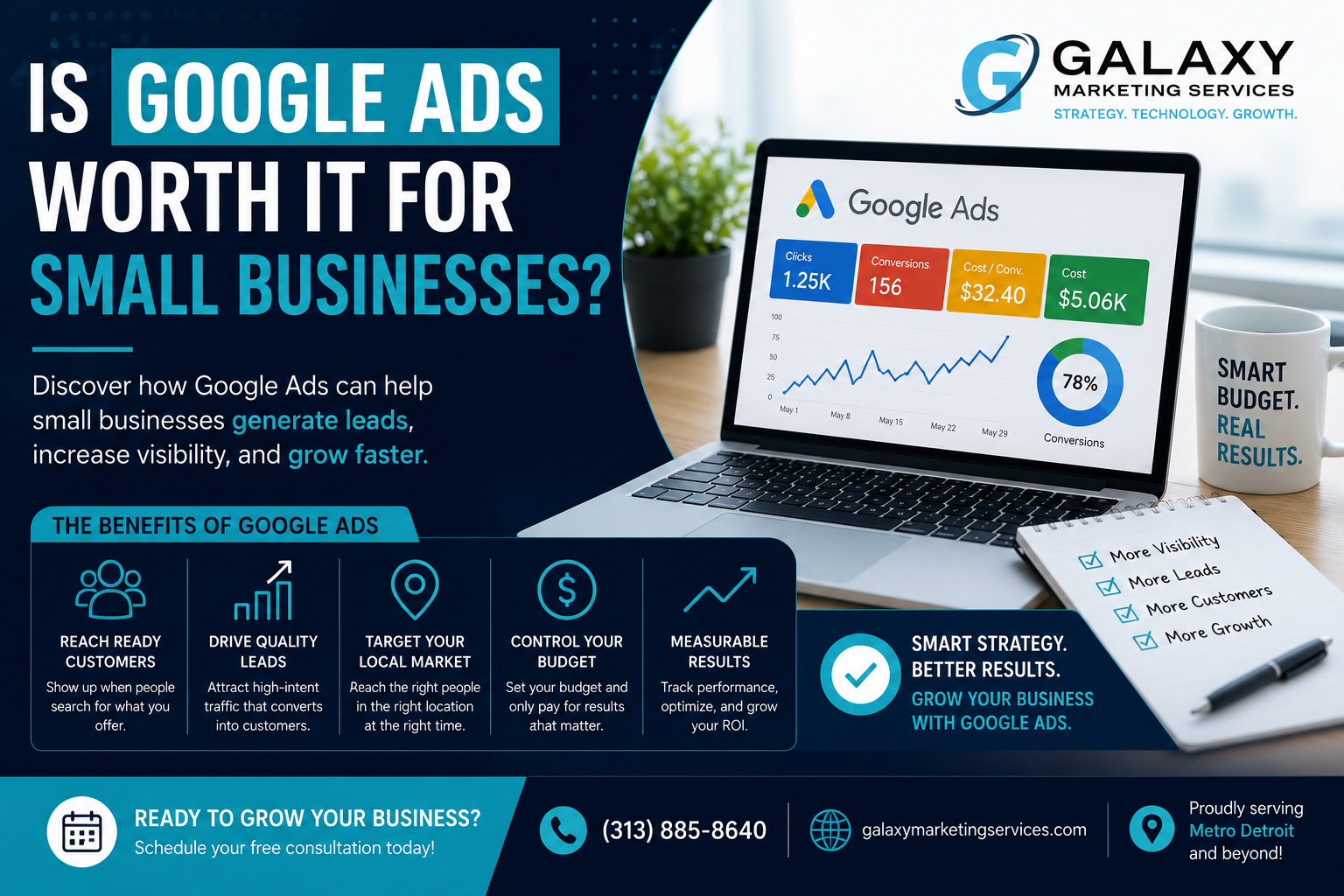
Yes, Google Ads can be very effective for small businesses when campaigns are properly targeted, tracked, and optimized. It is especially useful for businesses that rely on leads, phone calls, appointments, bookings, or quote requests.
The right budget depends on industry, competition, location, and goals. A realistic budget should be large enough to generate meaningful data so campaigns can be optimized over time.
Google Ads can start generating traffic quickly, but meaningful optimization usually takes time. Campaigns often need testing, data collection, keyword refinement, and landing page improvements before performance stabilizes.
For many small business owners, Google Ads can feel both exciting and intimidating. On one hand, it gives your business the ability to appear in front of people actively searching for your products or services. On the other hand, paid advertising can become expensive quickly if campaigns are not built, tracked, and optimized correctly.
So, is Google Ads worth it for small businesses?
In most cases, yes — but only when there is a clear strategy behind it.
Google Ads can be one of the fastest ways for small businesses to generate leads, increase website traffic, promote services, and compete in local markets. Unlike organic SEO, which takes time to build momentum, Google Ads allows your business to show up quickly for high-intent searches from people already looking for what you offer.
However, Google Ads is not magic. It works best when your campaign structure, keyword targeting, landing pages, budget, tracking, and follow-up process are all aligned. A poorly managed campaign can waste money. A well-managed campaign can become a predictable lead generation system.

What Makes Google Ads Valuable for Small Businesses?
The biggest advantage of Google Ads is search intent.
When someone searches for “roofing company near me,” “estate planning attorney,” “emergency plumber,” “local SEO services,” or “best catering company,” they are not casually browsing. They are actively looking for a solution.
That makes Google Ads different from many other forms of advertising. Instead of interrupting people who may or may not care, Google Ads allows businesses to appear when potential customers are already searching.
For small businesses, this matters because every marketing dollar needs to work harder. Google Ads can help businesses reach people at the exact moment they are considering a purchase, booking, consultation, appointment, or quote request.
When Google Ads Is Worth It
Google Ads is usually worth it when your business has a clear offer, strong margins, and a defined customer acquisition goal.
For example, Google Ads can be highly effective for businesses that rely on phone calls, form submissions, appointment requests, bookings, or quote requests. This includes industries such as home services, legal, medical, professional services, restaurants, catering, senior care, beauty, construction, and local service businesses.
Google Ads is especially valuable when the lifetime value of a customer is higher than the cost of acquiring that customer. If one new customer is worth hundreds or thousands of dollars, then a properly optimized campaign can make strong financial sense.
A small business does not need a massive budget to benefit from Google Ads. What matters more is whether the budget is focused, tracked, and spent on the right searches.
When Google Ads May Not Be Worth It
Google Ads may not be worth it if the business does not have the right foundation in place.
If your website is slow, confusing, outdated, or not built to convert, paid traffic may not produce strong results. Even if people click your ads, they may leave without calling, filling out a form, or taking action.
Google Ads may also struggle if your offer is unclear, your market is extremely competitive, your budget is too low to collect meaningful data, or your campaign is targeting broad keywords that attract the wrong audience.
For example, a campaign targeting “lawyer” will likely waste more money than a campaign targeting “estate planning attorney in Troy MI” or “probate lawyer near me.” Specificity matters.
Google Ads is most effective when it is treated as a performance system, not just an ad spend button.
The Biggest Mistake Small Businesses Make with Google Ads
The biggest mistake small businesses make is launching campaigns without proper tracking.
If you do not know which keywords, ads, and landing pages are generating phone calls, form submissions, purchases, or qualified leads, you cannot accurately judge performance.
Without tracking, business owners often make decisions based on surface-level metrics such as clicks, impressions, or cost per click. Those numbers matter, but they do not tell the full story.
The real question is not:
“How many clicks did we get?”
The real question is:
“How many qualified leads or customers did those clicks produce?”
Proper conversion tracking should measure actions such as:
- phone calls
- contact form submissions
- quote requests
- appointment bookings
- purchases
- direction clicks
- email clicks
- lead quality
Once tracking is in place, campaigns can be optimized toward actual business outcomes.
Google Ads vs SEO: Which Is Better for Small Businesses

Google Ads and SEO serve different purposes.
Google Ads can produce visibility quickly. SEO builds long-term organic visibility over time.
For small businesses, the strongest strategy is often using both together.
Google Ads can help generate leads while SEO is still growing. It can also reveal which keywords convert best, which services people search for most, and which landing pages drive the strongest engagement. That data can then support your SEO strategy.
SEO, on the other hand, can reduce long-term dependence on paid media by helping your website rank organically for valuable searches.
A strong digital growth strategy may use Google Ads for immediate lead generation while building SEO as a long-term traffic and authority engine.
What Determines Whether Google Ads Will Work?

Several factors determine whether Google Ads will be profitable for a small business.
Campaign Structure
Campaigns should be organized by service, location, intent, or product category. Poor structure leads to wasted spend and unclear performance data.
Keyword Targeting
Strong campaigns focus on high-intent keywords. Broad, vague keywords often attract low-quality traffic.
Landing Page Quality
The page people land on after clicking your ad matters. It should match the search intent, load quickly, explain the offer clearly, and make it easy to take action.
Ad Copy
Effective ad copy should speak directly to the user’s problem, highlight the value of the business, and include a strong call to action.
Budget
Small budgets can work, but they need to be realistic. If the market is competitive, too small of a budget may prevent the campaign from gathering enough data to optimize properly.
Conversion Tracking
Without tracking, optimization becomes guesswork.
Follow-Up Process
Even a strong campaign can fail if leads are not answered quickly. Speed-to-lead matters, especially for service businesses.
How Much Should Small Businesses Spend on Google Ads?


There is no universal budget that works for every business. The right budget depends on industry, location, competition, goals, and average customer value.
A local service business in a competitive market may need a larger budget than a niche business targeting a smaller area. A law firm, roofing company, or medical provider may face higher click costs than a local restaurant or boutique service provider.
Instead of asking, “What is the cheapest amount we can spend?” small businesses should ask:
“What budget gives us enough data to understand what is working?”
A campaign needs enough activity to test keywords, ads, landing pages, and audience behavior. If the budget is too limited, performance may appear weak simply because there is not enough data to optimize.
How to Make Google Ads More Profitable
Google Ads becomes more profitable when businesses focus on quality, not just traffic.
To improve performance, small businesses should:
- target high-intent keywords
- use negative keywords to block irrelevant searches
- send users to dedicated landing pages
- track calls and form submissions
- improve page speed and mobile experience
- write clear ad copy
- test different offers
- monitor search terms regularly
- optimize based on lead quality
- connect campaigns to CRM or follow-up systems
The best campaigns are not “set it and forget it.” They are continuously refined based on real performance data.
Why Landing Pages Matter for Google Ads

A common mistake is sending all paid traffic to the homepage.
Your homepage may explain your business, but it is not always the best place to convert ad traffic. People clicking Google Ads usually have a specific need. A dedicated landing page can speak directly to that need.
For example, if someone searches for “commercial HVAC maintenance,” they should land on a page specifically about commercial HVAC maintenance, not a general homepage with every service listed.
A strong landing page should include:
- a clear headline
- service-specific copy
- trust signals
- testimonials or proof
- simple contact options
- click-to-call functionality
- strong calls to action
- FAQs
- mobile-friendly design
Better landing pages often lead to better conversion rates and lower wasted spend.
Is Google Ads Good for Local Businesses?
Yes, Google Ads can be especially valuable for local businesses because it allows precise geographic targeting.
Local businesses can target specific cities, ZIP codes, counties, or service areas. This helps avoid wasting money on clicks from people outside the business’s actual market.
Google Ads can support local businesses such as:
- contractors
- roofers
- HVAC companies
- law firms
- medical practices
- salons
- restaurants
- catering companies
- senior care providers
- locksmiths
- property management companies
- professional service firms
When paired with Google Business Profile optimization and local SEO, Google Ads can become part of a stronger local search strategy.


What Are the Risks of Google Ads?
The biggest risk is wasted spend.
Google Ads can waste money if campaigns are built too broadly, tracking is missing, ads are not optimized, or leads are not followed up with quickly.
Common risks include:
- targeting the wrong keywords
- using broad match without control
- failing to add negative keywords
- sending traffic to weak pages
- not tracking conversions
- ignoring lead quality
- running ads without a clear offer
- setting unrealistic budget expectations
- not reviewing campaign performance regularly
The platform itself is powerful, but performance depends heavily on strategy and management.
Final Answer: Is Google Ads Worth It for Small Businesses?
Google Ads is worth it for many small businesses, but only when it is managed strategically.
It is most valuable when your business has a clear service, strong offer, optimized website, defined target market, realistic budget, and proper conversion tracking.
Google Ads can help small businesses generate leads faster than SEO alone, test market demand, promote high-value services, and compete in local search results. But it should not operate in isolation. The strongest results come when Google Ads works alongside SEO, website optimization, Google Business Profile management, landing page strategy, and strong follow-up systems.
For small businesses serious about growth, Google Ads can absolutely be worth the investment.
The key is making sure every dollar is connected to a measurable business goal.
Ready to Improve Your Google Ads?
Contact our team to learn how we can improve your visibility, increase traffic, and turn your ads into a long-term growth asset.