
The best type of marketing depends on your business goals. SEO works well for long-term visibility, Google Ads works well for immediate lead generation, local SEO works well for local businesses, and email marketing works well for follow-up and retention.
Not always. A dedicated landing page is often better for a specific service because it can match the ad, focus on one audience, remove distractions, and use one clear call to action.
Yes. Forms, calls, bookings, or purchases may not be recorded if the tracking setup is missing or broken. Test every conversion action manually and confirm that it appears in Google Ads and your CRM.
The account may be counting actions such as contact-page visits, button clicks, video views, or form starts as conversions. Only meaningful outcomes should be treated as primary conversion goals.
Yes. Users may leave before calling or completing a form if the page loads slowly or is difficult to use on mobile.
Frequently Asked Questions About Google Ads Clicks and Leads
Why am I getting clicks but no conversions in Google Ads?
Your campaign may be attracting irrelevant searches, targeting low-intent keywords, sending visitors to a weak landing page, using an unclear offer, or failing to track leads properly. Search terms, location targeting, forms, phone calls, landing pages, and conversion settings should all be reviewed.
Should I send Google Ads traffic to my homepage?
Not always. A dedicated landing page is often better for a specific service because it can match the ad, focus on one audience, remove distractions, and use one clear call to action.
Can conversion tracking make it look like I have no leads?
Yes. Forms, calls, bookings, or purchases may not be recorded if the tracking setup is missing or broken. Test every conversion action manually and confirm that it appears in Google Ads and your CRM.
Why does Google Ads show conversions when I am not getting real leads?
The account may be counting actions such as contact-page visits, button clicks, video views, or form starts as conversions. Only meaningful outcomes should be treated as primary conversion goals.
Can a slow website reduce Google Ads leads?
Yes. Users may leave before calling or completing a form if the page loads slowly or is difficult to use on mobile.
Should I pause a campaign that is getting clicks but no leads?
Do not automatically pause the campaign before identifying the cause. Restrict spending if tracking is broken, search terms are irrelevant, the landing page does not work, or the targeting is clearly wrong. Continue testing carefully when the campaign has strong intent but limited data.
Google Ads can be one of the fastest ways to put your business in front of people who are actively searching for what you offer. That is what makes it so frustrating when a campaign appears to be working on the surface, but the actual results are not there.
The ads are running. People are clicking. The budget is being spent. Yet the phone is not ringing, the contact forms are not coming through, and the campaign is not producing enough qualified leads.
This is one of the most common problems businesses experience with paid search.
The issue is rarely that Google Ads simply “does not work.” More often, the campaign is attracting the wrong searches, sending users to the wrong page, creating friction after the click, or failing to track the actions that matter.
A click is only the beginning of the process. It tells you that someone saw your ad and found it interesting enough to visit your website. It does not tell you whether that person was qualified, ready to buy, located in your service area, or convinced by what they found after they landed.
To understand why clicks are not becoming leads, you have to look at the entire journey from the original search to the final follow-up.
At Galaxy Marketing Services, we often see the best results when businesses combine visibility, trust, conversion strategy, and follow-up systems. In other words, successful marketing is not just about getting attention. It is about creating a path from awareness to action.

Clicks Are Not the Same as Results
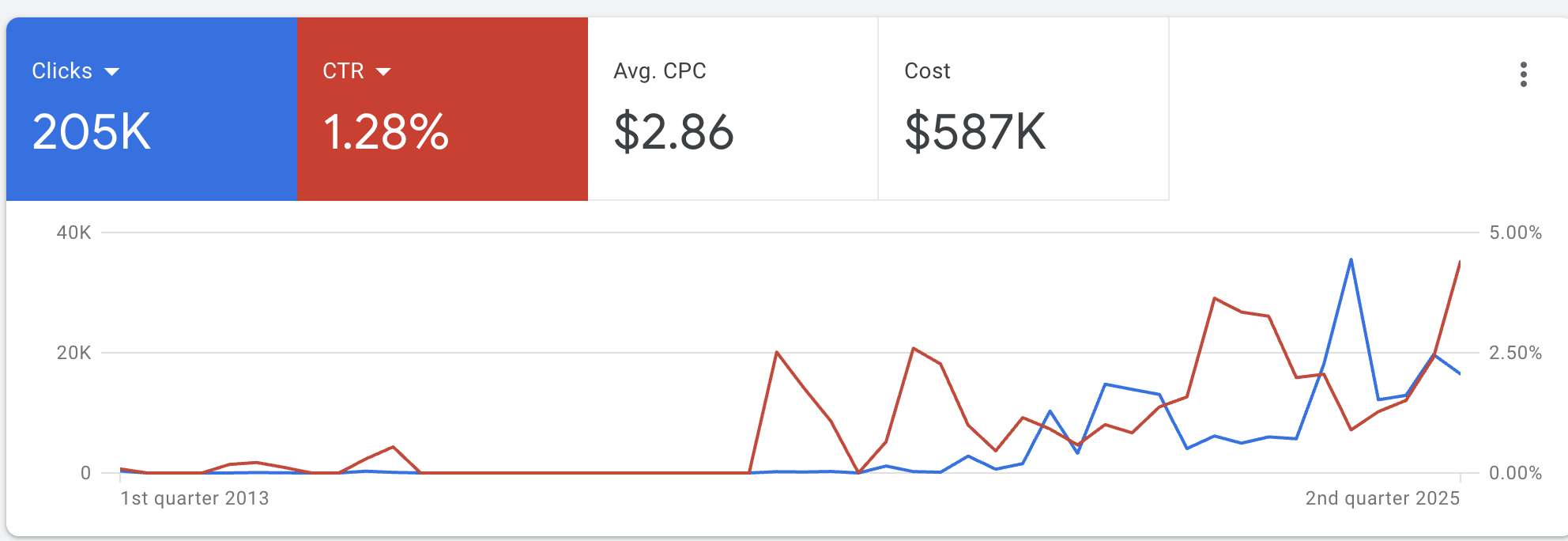
It is easy to focus on clicks because they are one of the most visible metrics inside Google Ads. They make the campaign feel active, and a rising click-through rate can make it appear that the ads are improving.
But clicks alone do not create revenue.
For a lead-generation campaign, the real goal is usually a phone call, contact form, consultation request, appointment, application, or quote request. These are the actions that move someone from being a visitor to becoming a potential customer.
A campaign can generate hundreds of clicks and still perform poorly if those visitors never take the next step.
That is why the more important questions are:
- Are the right people clicking?
- Are they seeing the right message?
- Are they landing on a page that matches what they searched for?
- Can they quickly understand why they should contact the business?
- Is the conversion action easy to complete?
- Is the company following up properly afterward?
When any part of that sequence breaks down, the campaign can continue spending money without producing meaningful results.
The Problem Often Starts Before the Click
Many businesses assume that if someone clicked the ad, the targeting must have been correct. That is not always true.
Google Ads can show your ads for searches that are related to your keywords without being commercially valuable to your business.
For example, a company advertising Google Ads management might target a phrase such as “Google Ads help.” That sounds relevant, but the actual searches could include people looking for free tutorials, certification support, customer service, login help, jobs, or instructions for canceling an account.
All of those users may click the ad, but very few are likely to become clients.
This is why the search terms report is so important. The keywords inside the campaign show what you intended to target. The search terms report shows what people actually typed.
That difference can explain a large amount of wasted spend.
A commercial cleaning company might target “commercial cleaning company,” while the campaign appears for searches involving jobs, salaries, supplies, training, templates, or how to start a cleaning business.
The keyword may look correct in the account, but the traffic can still be wrong.
Negative keywords help prevent this by blocking searches that do not fit the campaign. Terms such as “jobs,” “salary,” “free,” “course,” “template,” or “DIY” may be useful exclusions for some businesses. They should not be applied blindly, however. The right negative keywords depend on the service, audience, and actual search data.
A staffing company, for example, would not automatically exclude “jobs,” but it may need separate campaigns for employers and candidates so those audiences do not become mixed together.
Search Intent Matters More Than Search Volume
Another reason campaigns generate clicks without leads is that the keywords are attracting people who are researching rather than people who are ready to hire.
Someone searching “what is SEO” is probably trying to learn.
Someone searching “SEO company Detroit” is more likely to compare providers.
Someone searching “hire SEO agency near me” may be close to contacting a business.
Those searches are all related to the same topic, but they represent very different levels of intent.
Informational searches can be valuable for organic content, remarketing, or long-term brand awareness. They are usually less effective when used as the core of a direct-response Google Ads campaign.
Lead-generation campaigns generally perform better when they focus on searches that include stronger commercial signals, such as:
- Company
- Agency
- Near me
- Pricing
- Quote
- Consultation
- Hire
- Service
- Management
- Provider
The goal is not to eliminate every research-oriented search. It is to make sure the campaign budget is concentrated around people who are more likely to take action.
A campaign can attract a large amount of traffic and still fail because the intent behind that traffic is too weak.
Location Targeting Can Quietly Waste Budget
FGeographic targeting is another area where campaigns often appear more relevant than they really are.
A local business may intend to target one city or a small service radius but receive clicks from users outside that area. A company serving Metro Detroit may receive traffic from other parts of Michigan. A national campaign may accidentally attract users from other countries. A recruiter may generate applications from markets where there are no available roles.
Those clicks still cost money.
The problem may come from targeting settings, overly broad market coverage, or language in the ad that does not clearly define the service area.
Reviewing performance by city, ZIP code, county, state, and distance from the business can reveal patterns that are easy to miss at the campaign level.
You may find that one location generates strong leads while another spends consistently without producing anything. You may discover that the campaign performs well within 15 miles but declines sharply beyond that range.
Improving geographic performance does not always mean shrinking the campaign. It may mean creating separate campaigns for important markets, using city-specific landing pages, adjusting budgets by location, or writing ads that speak directly to each audience.
A user searching for a service in Royal Oak is more likely to respond to a page that clearly references Royal Oak than a generic page written for everyone.
The Ad and Landing Page Need to Tell the Same Story

Even when the right person clicks, the campaign can fail if the landing page does not deliver what the ad promised.
The ad creates an expectation.
The landing page needs to confirm that expectation immediately.
If a user clicks an ad for “Google Ads Management for Detroit Businesses” and lands on a general homepage discussing branding, web design, social media, app development, and SEO, the visitor has to work to determine whether the service they searched for is actually available.
That extra effort creates friction.
A strong journey should feel consistent from beginning to end.
The search might be:
Google Ads agency Detroit
The ad might say:
- Detroit Google Ads Management
- The landing page headline might say:
- Google Ads Management for Detroit Businesses
- The call to action might say:
- Request a Google Ads Consultation
Each step reassures the visitor that they are in the right place.
A weaker journey might use broad language such as “Grow Your Business Online” and then send the visitor to a homepage with no clear service-specific direction. The message may sound polished, but it does not provide enough clarity.
This is one reason dedicated landing pages often outperform homepages for paid traffic.
A homepage has to introduce the entire company. A landing page can focus on one service, one audience, one offer, and one next step.
Your Website May Be Losing the Lead After the Click

Once users reach the page, they quickly evaluate whether the business looks credible, relevant, and easy to work with.
Paid traffic often includes people who have never heard of the company before. They may also be comparing several competitors at the same time.
The page needs to answer practical questions quickly:
- What does this company do?
- Does it serve my location?
- Does it understand my problem?
- Why should I trust it?
- What happens if I contact them?
- What should I do next?
A page that does not answer those questions creates uncertainty.
Trust can be strengthened through reviews, testimonials, case studies, team information, client logos, professional affiliations, service details, process explanations, and clear contact information.
Specific proof is more persuasive than vague claims.
“We are the best digital marketing agency” does not explain much.
“We help service businesses improve lead generation through Google Ads, conversion tracking, landing pages, and ongoing campaign optimization” gives the visitor a clearer reason to continue.
A Weak Call to Action Can Stop an Otherwise Good Campaign


Some campaigns have relevant traffic and a solid landing page but still fail because the next step is unclear or unconvincing.
Calls to action such as “Learn More,” “Submit,” or “Get Started” are common, but they do not always tell the user what they will receive.
More specific options can reduce uncertainty:
- Request a Free Consultation
- Get a Google Ads Review
- Request a Quote
- Schedule a Strategy Call
- Check Service Availability
- Speak With a Specialist
The best call to action depends on the business and the stage of the buying process.
A local contractor may want users to call.
A B2B company may want consultation bookings.
A recruiter may need separate actions for employers and candidates.
The page should also avoid competing calls to action. When visitors are asked to download a guide, follow the company on social media, join a newsletter, read the blog, view all services, and schedule a call at the same time, the number of options can reduce action rather than increase it.
One primary conversion goal is usually easier to understand and optimize.
Forms Often Create More Friction Than Businesses Realize
A contact form can become a major barrier when it asks for too much information too early.
Businesses often add fields because the information would be useful to the sales team. But every required field asks the user to invest more time and trust.
A visitor seeking an initial consultation may not be ready to provide annual revenue, company size, full address, project budget, desired timeline, multiple service selections, and a detailed explanation.
For many lead-generation campaigns, a simpler form may be enough:
- Name
- Phone
- Company
- Short message
That does not mean every form should be short. A high-value commercial project may require more qualification. The form should simply match the level of commitment the visitor is being asked to make.
It is also important to test the form regularly.
A campaign can appear to be generating no leads when the real problem is a technical failure. The form may not submit properly, the notification email may go to spam, the CRM connection may be broken, or the confirmation page may not load.
The entire process should be tested on desktop and mobile devices.
Mobile Performance Can Make or Break the Campaign

A large share of paid search traffic comes from mobile devices, especially for local service businesses.
A landing page that looks acceptable on desktop can still be difficult to use on a phone.
Common problems include:
- Slow loading
- Oversized images
- Small text
- Popups blocking content
- Buttons placed too close together
- Forms that are hard to complete
- Phone numbers that are not clickable
- Calls to action buried too far down the page
- Layout shifts while the page loads
A mobile visitor should be able to understand the offer quickly, tap the phone number easily, complete the form without frustration, and see trust signals without excessive scrolling.
The page should also load well on cellular data, not only on a fast office connection.
When campaigns receive clicks but no leads, mobile usability should always be part of the review.
The Campaign May Be Working, but the Tracking Is Not
Sometimes the business is receiving leads, but Google Ads is not recording them correctly.
This is common with phone calls, booking tools, third-party forms, external scheduling pages, and CRM systems.
Conversion tracking can fail when:
- The tag is missing
- The form event does not fire
- The tag fires before submission is complete
- The same conversion is counted multiple times
- Calls are not tracked
- The booking happens on another domain
- The thank-you page is accessible without submitting the form
- Google Analytics events are imported incorrectly
- Primary and secondary goals are configured incorrectly
Before rebuilding the campaign, the tracking setup should be verified.
- Complete the form yourself.
- Call the tracked number.
- Schedule an appointment.
- Check whether the lead reaches the inbox or CRM.
- Confirm that the event appears in Analytics and Google Ads.
Without accurate tracking, it is impossible to judge campaign performance properly.
It can also confuse automated bidding. If Google is optimizing toward weak or incorrect conversion signals, it may begin finding more users who complete those low-value actions instead of users who become actual customers.
Not Every Conversion Should Be Treated as a Lead
Some accounts report plenty of conversions, yet the business still feels like it is receiving no meaningful inquiries.
That often happens because the account is counting micro-conversions as if they were leads.
Examples include:
- Visiting the contact page
- Clicking a button
- Watching a video
- Scrolling down the page
- Spending time on the website
- Opening a form
- Clicking an email address
These actions may be useful for analysis, but they are not the same as a completed inquiry, qualified phone call, appointment, application, or purchase.
Primary conversions should represent meaningful business outcomes.
Secondary actions can still be tracked, but they should not necessarily guide bidding as if they produce revenue.
When the account is optimized around weak signals, the campaign may look successful inside Google Ads while producing little business value.
Budget and Campaign Structure Can Dilute Performance
A small budget spread across too many services, locations, and campaign types can lead to scattered results.
A business spending $1,000 per month might try to advertise:
- SEO
- Google Ads
- Web design
- Branding
- Social media
- App development
- Automation
- Email marketing
- Multiple cities
Each area receives only a limited number of clicks, making it difficult to gather useful data or achieve enough volume to convert consistently.
A more focused approach may be more effective:
- One high-value service.
- One defined audience.
- One primary market.
- One landing page.
- One conversion goal.
Once that campaign becomes reliable, the account can expand.
Focus does not guarantee success, but it creates clearer data and makes problems easier to identify.
The Offer May Not Be Strong Enough
Even when the targeting and landing page are relevant, visitors may still leave because the offer does not feel compelling.
They may not understand what makes the company different.
The pricing may appear too high or too vague.
The process may feel unclear.
The commitment may feel too large.
Competitors may offer a faster or lower-risk next step.
This does not mean the business needs to discount the service.
It means the value needs to be communicated more clearly.
“Contact us for marketing services” is broad.
“Request a paid search review to identify wasted spend, tracking gaps, and opportunities to improve lead quality” gives the visitor a more specific reason to act.
Lower-friction entry offers can work well for service businesses. These may include audits, consultations, assessments, demos, estimates, or second opinions.
Your Ads May Be Attracting Attention Instead of Buyers
A high click-through rate can be misleading.
Broad, emotional headlines may generate curiosity without attracting qualified prospects.
Phrases such as “Transform Your Business Today” or “Unlock Unlimited Growth” may sound appealing, but they do not explain what the business does, who it helps, or where it operates.
A more specific ad may receive fewer clicks but produce better traffic.
For example:
“Google Ads Management for Detroit Service Businesses”
is less flashy, but it qualifies the audience before they click.
For lead generation, the goal is not the highest possible number of clicks. It is the right clicks.
Strong ads typically communicate the service, audience, location, outcome, and next step as clearly as possible.
The Sales Process Matters After the Lead Arrives
Google Ads can generate an inquiry, but it cannot make the business respond.
Leads are often lost after conversion because:
- Calls go unanswered
- Voicemails are not returned
- Form notifications go to spam
- No one is assigned to the lead
- Responses take too long
- The first message is generic
- There is no scheduling option
- Sales notes are not recorded
- Follow-up is inconsistent
Many prospects contact more than one company.
The business that responds quickly and clearly often has an advantage.
This is why campaign performance should be measured beyond the form submission.
Track:
- Response time
- Contact rate
- Qualification rate
- Appointment rate
- Proposal rate
- Close rate
- Revenue per lead
A campaign can generate qualified leads and still appear unsuccessful if the follow-up system is weak.


How to Diagnose the Real Problem
When clicks are not becoming leads, avoid changing everything at once.
Start by confirming that the conversion path works.
Test the form, phone number, booking tool, CRM, and tracking.
Then review search terms to see whether the traffic is relevant.
Look at keyword intent, geographic performance, device performance, and landing-page behavior.
Compare the ad message to the page headline.
Check whether users can understand the offer immediately.
Review the form length, call to action, trust signals, mobile experience, and page speed.
Then look beyond the account and evaluate what happens after the inquiry.
This process helps identify whether the main problem is traffic quality, website performance, measurement, or sales follow-up.e.
How to Turn More Clicks Into Leads
Improving performance usually requires alignment across four areas.
The first is traffic quality. The campaign should prioritize commercially relevant searches, use negative keywords, separate different services, and target locations intentionally.
The second is the landing experience. The page should match the ad, focus on one service, build trust, load quickly, and make the next step obvious.
The third is measurement. Forms, calls, bookings, and qualified leads should be tracked accurately. Primary and secondary actions should be separated.
The fourth is follow-up. Leads should reach the right person immediately, receive a professional response, and remain visible inside the CRM until they are closed or disqualified.
When those areas work together, Google Ads becomes more than a traffic source. It becomes part of a measurable lead-generation system.
Turn Google Ads Traffic Into Real Business Opportunities
Clicks are not the final goal.
They are the start of the customer journey.
When a campaign receives traffic but produces few leads, something between the search and the sale is out of alignment.
The wrong people may be clicking.
The ad may be too broad.
The landing page may not match the promise.
The website may not build enough trust.
The form may create friction.
Tracking may be incomplete.
Follow-up may be too slow.
The strongest Google Ads campaigns connect keyword strategy, ad messaging, landing pages, conversion tracking, and sales follow-up into one system.
Galaxy Marketing Services helps businesses improve Google Ads performance through paid search strategy, campaign management, landing-page development, conversion tracking, search-term analysis, and ongoing optimization.
When these pieces work together, businesses can move beyond paying for clicks and begin generating more qualified opportunities.
Are your Google Ads getting clicks without enough leads? Contact Galaxy Marketing Services to review your campaign, tracking, landing pages, and conversion process.
The best marketing strategy is not about doing everything. It is about doing the right things in the right order.
Need Help Choosing Your Google Ads?
At Galaxy Marketing Services, we help businesses build marketing strategies designed around visibility, lead generation, conversion, automation, and measurable growth.
Whether you need SEO, Google Ads, website design, local SEO, content marketing, or a complete digital strategy, our team can help you create a plan that fits your goals.
Schedule a consultation today to build a smarter marketing strategy for your business.