
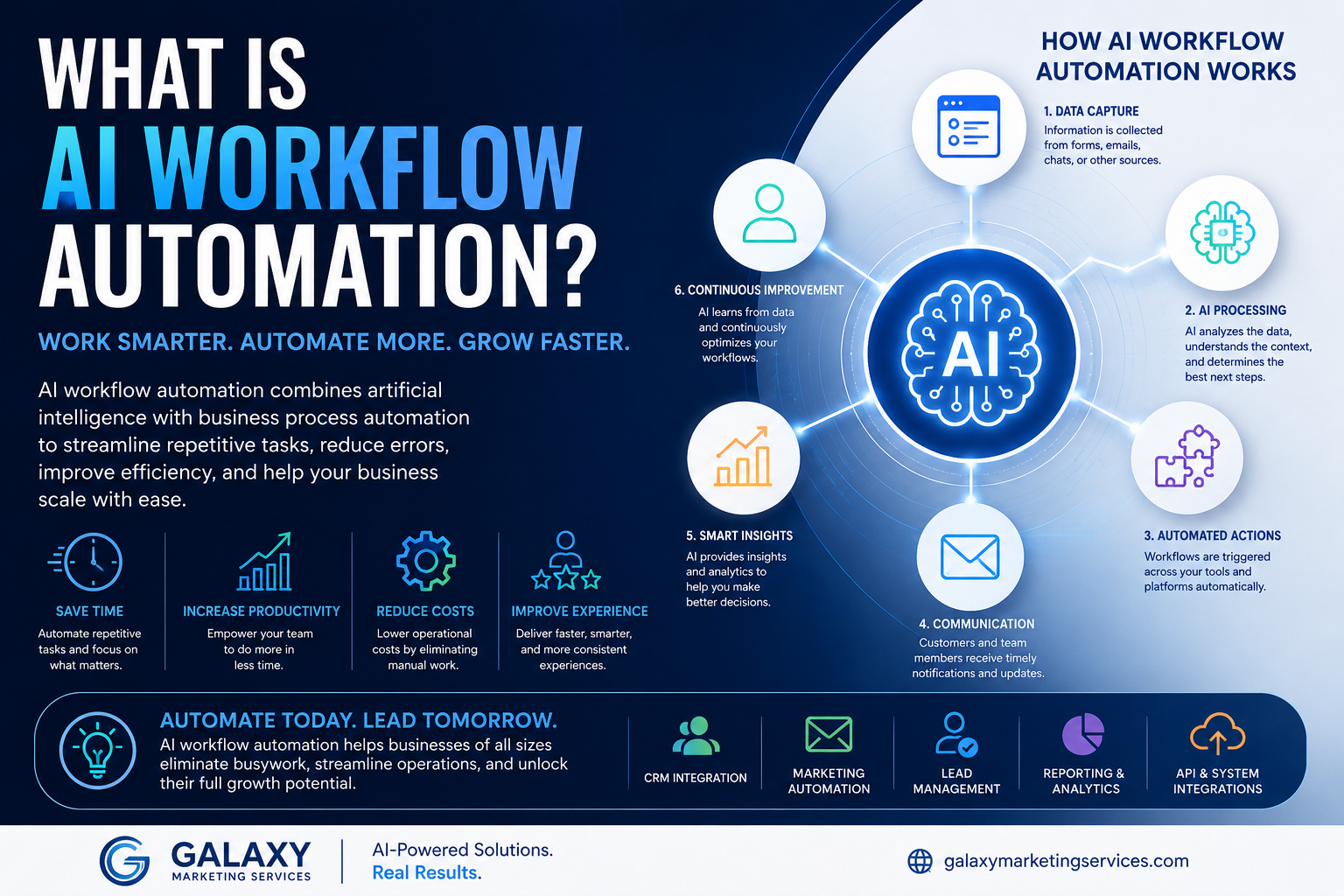
AI workflow automation uses artificial intelligence to automate repetitive business processes, make data-driven decisions, and connect systems without requiring constant manual intervention. It helps organizations improve efficiency, reduce errors, and save time.
AI workflow automation helps businesses reduce manual work, increase productivity, improve accuracy, accelerate response times, lower operating costs, and create more consistent customer experiences. It also allows employees to focus on higher-value strategic tasks.
Common AI automation use cases include lead management, customer service, email marketing, invoice processing, employee onboarding, appointment scheduling, CRM updates, document processing, reporting, and data synchronization between business systems.
Yes. AI workflow automation can help small businesses operate more efficiently by automating repetitive administrative tasks, improving customer communication, reducing labor costs, and allowing owners to spend more time growing their business.
Google Ads can begin generating traffic almost immediately after campaigns launch. However, improving performance usually requires ongoing optimization over several weeks or months as data is collected and campaign adjustments are made.
What Is AI Workflow Automation? A Complete Guide for Modern Businesses
Frequently Asked Questions About Google Ads Clicks and Leads
Why am I getting clicks but no conversions in Google Ads?
Your campaign may be attracting irrelevant searches, targeting low-intent keywords, sending visitors to a weak landing page, using an unclear offer, or failing to track leads properly. Search terms, location targeting, forms, phone calls, landing pages, and conversion settings should all be reviewed.
Should I send Google Ads traffic to my homepage?
Not always. A dedicated landing page is often better for a specific service because it can match the ad, focus on one audience, remove distractions, and use one clear call to action.
Can conversion tracking make it look like I have no leads?
Yes. Forms, calls, bookings, or purchases may not be recorded if the tracking setup is missing or broken. Test every conversion action manually and confirm that it appears in Google Ads and your CRM.
Why does Google Ads show conversions when I am not getting real leads?
The account may be counting actions such as contact-page visits, button clicks, video views, or form starts as conversions. Only meaningful outcomes should be treated as primary conversion goals.
Can a slow website reduce Google Ads leads?
Yes. Users may leave before calling or completing a form if the page loads slowly or is difficult to use on mobile.
Should I pause a campaign that is getting clicks but no leads?
Do not automatically pause the campaign before identifying the cause. Restrict spending if tracking is broken, search terms are irrelevant, the landing page does not work, or the targeting is clearly wrong. Continue testing carefully when the campaign has strong intent but limited data.
Artificial intelligence has become one of the fastest-growing technologies in modern business, but many organizations are still asking the same question: What is AI workflow automation, and how can it help my business?
For decades, businesses have relied on employees to complete repetitive administrative work. Entering customer information, responding to emails, generating reports, updating spreadsheets, assigning leads, scheduling appointments, creating invoices, and moving data between software platforms all require valuable time. While each task may only take a few minutes, together they consume hundreds of hours every month.
AI workflow automation is changing that.
By combining artificial intelligence with business process automation, companies can streamline repetitive work, reduce manual errors, improve customer experiences, and allow employees to spend more time on strategic initiatives that actually grow the business.
Unlike traditional automation, modern AI systems don’t simply follow a rigid set of instructions. They can analyze information, recognize patterns, make recommendations, generate content, categorize requests, and even help determine the next best action.
Businesses of every size—from small local companies to enterprise organizations—are now investing in AI workflow automation to improve efficiency, reduce operating costs, and remain competitive in an increasingly digital marketplace.
Whether you’re a healthcare provider, law firm, contractor, manufacturer, retailer, or professional service company, AI has the potential to transform the way your organization operates.
What Is AI Workflow Automation?
AI workflow automation is the process of using artificial intelligence to automate business tasks, streamline operations, and improve decision-making throughout an organization.
Instead of requiring employees to manually perform repetitive activities, AI-powered workflows automatically process information, trigger actions, communicate with software platforms, and assist with business decisions based on predefined goals and learned patterns.
Traditional automation simply follows instructions.
Artificial intelligence adds intelligence to those instructions.
Rather than saying:
“If a customer fills out this form, send an email.”
An AI workflow can instead determine:
- What service the customer is requesting
- How qualified the lead appears
- Which salesperson should receive the lead
- Whether the inquiry is urgent
- Which follow-up email is most appropriate
- When a reminder should be scheduled
- Which marketing campaign the lead should enter
The result is a workflow that feels far more intelligent while requiring significantly less manual work.
How Does AI Workflow Automation Work?
Although every business is different, most AI workflows follow a similar process.
Information enters the business from a website, CRM, customer portal, email, online purchase, phone call, or another connected system.
Artificial intelligence then analyzes that information before determining the next steps.
A typical workflow may look like this:
- A customer submits a website form.
- AI analyzes the request.
- The CRM automatically creates a new contact.
- The lead is scored based on business rules.
- The appropriate salesperson is assigned.
- A personalized email is generated.
- A follow-up reminder is scheduled.
- Management dashboards update automatically.
- Performance metrics are logged for reporting.
The entire process may take only a few seconds, allowing businesses to respond much faster than manual processes ever could.
AI Workflow Automation vs. Traditional Automation
Businesses have been automating repetitive tasks for many years.
Traditional automation is excellent at handling predictable, repetitive actions. However, it struggles whenever interpretation or decision-making becomes necessary.
AI workflow automation expands those capabilities by allowing software to evaluate information before determining what should happen next.
| Traditional Automation | AI Workflow Automation |
|---|---|
| Rule-based | Learns patterns |
| Static workflows | Adaptive workflows |
| Limited decision-making | AI-assisted recommendations |
| Simple repetitive tasks | Complex business processes |
| Manual categorization | Intelligent classification |
| Fixed responses | Context-aware responses |
Instead of replacing traditional automation, AI enhances it by making workflows more flexible and intelligent.
Benefits of AI Workflow Automation
Organizations implement AI for many different reasons, but the benefits often extend far beyond simple time savings.
Companies frequently experience improvements in productivity, customer satisfaction, reporting accuracy, and operational consistency after automating repetitive workflows.
Some of the biggest advantages include:
- Reduced manual data entry
- Faster customer response times
- Improved employee productivity
- Fewer administrative errors
- Better reporting and analytics
- Increased scalability
- Lower operating costs
- More consistent customer experiences
- Better visibility into business performance
- Improved decision-making
These benefits become even more valuable as a business continues to grow.
Without automation, increasing sales often requires increasing administrative staff. AI allows organizations to grow more efficiently by handling much of the repetitive work automatically.
Common Business Processes That Can Be Automated

Almost every department contains repetitive tasks that are excellent candidates for automation.
Rather than viewing AI as a single tool, it’s more helpful to think of it as a digital assistant capable of supporting multiple business functions simultaneously.
Marketing Automation
Marketing teams generate enormous amounts of data every day.
AI helps organize that information while improving campaign performance.
Common marketing automations include:
- Lead generation
- Email marketing
- Customer segmentation
- Social media scheduling
- Content generation
- SEO reporting
- Google Ads reporting
- Campaign performance analysis
- Lead scoring
- Review monitoring
Instead of manually compiling reports every week, marketing teams can receive AI-generated summaries that identify opportunities for improvement.
Sales Automation
Sales professionals often spend nearly as much time updating software as they do speaking with prospects.
AI helps eliminate much of that administrative workload.
Sales automations commonly include:
- CRM updates
- Appointment scheduling
- Proposal generation
- Follow-up reminders
- Lead qualification
- Opportunity tracking
- Pipeline reporting
- Quote creation
- Email drafting
This allows sales teams to focus more on building relationships instead of managing spreadsheets.
Customer Service Automation
Customer expectations continue to rise.
People want answers quickly.
AI workflow automation allows businesses to provide faster responses without sacrificing quality.
Examples include:
- AI chat assistants
- Ticket routing
- FAQ responses
- Appointment confirmations
- Customer surveys
- Status notifications
- Knowledge base recommendations
- Support request prioritization
Employees can then focus on complex customer issues that require personal attention.
Human Resources
HR departments also benefit from intelligent automation.
Examples include:
- Resume screening
- Employee onboarding
- Interview scheduling
- Benefits documentation
- Policy distribution
- Training reminders
- Performance review scheduling
Administrative tasks that previously required hours of manual coordination can often be completed automatically.
Finance & Operations
Financial and operational workflows are particularly well suited for automation because they involve large amounts of structured data.
Examples include:
- Invoice processing
- Expense categorization
- Financial reporting
- Purchase approvals
- Inventory monitoring
- Vendor communication
- Internal notifications
- Document management
This improves both speed and accuracy across the organization.
Real-World Examples of AI Workflow Automation

Roofing Contractor
A homeowner requests an estimate online.
Instead of simply sending an email notification, AI can:
- Analyze the requested service
- Determine the project location
- Verify the service area
- Create a CRM record
- Assign the correct estimator
- Schedule a follow-up reminder
- Send a confirmation email
The customer receives immediate communication while the sales team begins working with complete information.
Law Firm
A prospective client submits a consultation request.
The workflow automatically:
- Determines the legal practice area
- Assigns the proper attorney
- Creates a client record
- Sends intake forms
- Schedules a consultation
- Updates reporting dashboards
No manual routing is required.
Healthcare Practice
A patient books an appointment.
AI automatically:
- Confirms the appointment
- Sends reminder messages
- Delivers new patient paperwork
- Updates the patient database
- Notifies office staff
- Sends post-visit surveys
The patient receives a smoother experience while office staff spend less time managing administrative work.
Industries Using AI Workflow Automation


AI is no longer reserved for technology companies.
Organizations across nearly every industry are adopting intelligent automation.
Industries embracing AI include:
- Healthcare
- Legal
- Construction
- Manufacturing
- Financial Services
- Real Estate
- Property Management
- Restaurants
- Retail
- Automotive
- Professional Services
- Nonprofit Organizations
- Government Agencies
- Education
Although the workflows vary, the overall objective remains the same—reducing repetitive work while improving operational efficiency.
AI Workflow Automation and Digital Marketing
Digital marketing has become one of the most exciting applications for AI.
Marketing generates massive amounts of performance data across websites, advertising campaigns, social media platforms, email marketing, and customer relationship management systems.
Artificial intelligence can organize that information far more quickly than manual reporting.
AI-powered marketing workflows frequently include:
- Google Ads optimization
- SEO monitoring
- Keyword opportunity analysis
- Website reporting
- Email personalization
- Customer segmentation
- Content recommendations
- Conversion tracking
- Lead nurturing
- Marketing dashboards
Instead of spending hours reviewing reports, businesses can immediately identify trends and opportunities.
Is AI Replacing Employees?

One of the biggest misconceptions surrounding artificial intelligence is that it exists to replace people.
In reality, successful businesses use AI to eliminate repetitive work—not human expertise.
Employees still provide creativity, relationship building, strategic thinking, and decision-making that artificial intelligence cannot replicate.
AI simply helps employees become more productive.
Rather than spending hours copying information between software platforms, employees can spend more time serving customers, improving products, solving problems, and growing the business.
Businesses using AI effectively often discover they can accomplish significantly more without increasing administrative workloads.
Choosing the Right AI Workflow Platform
Every organization has different software, processes, and goals.
Choosing the right automation platform depends on how those systems need to communicate.
Some of today’s most popular automation platforms include:
- OpenAI
- ChatGPT
- n8n
- Zapier
- Make
- HubSpot
- Google Workspace
- Microsoft 365
- Salesforce
- Slack
- Notion
- Airtable
These platforms allow businesses to connect websites, CRMs, marketing software, calendars, accounting systems, customer portals, and internal databases into one connected ecosystem.
The best solution is rarely a single platform. Instead, successful AI implementations typically combine multiple technologies into a customized workflow tailored to the organization’s operations.

How to Get Started with AI Workflow Automation
Businesses often assume automation requires rebuilding their entire operation.
Fortunately, that’s rarely necessary.
The most successful AI projects typically begin with one repetitive process before expanding gradually over time.
A practical implementation often follows these steps:
- Identify repetitive manual tasks.
- Document the existing workflow.
- Determine which software platforms are involved.
- Identify opportunities for automation.
- Build and test the workflow.
- Monitor performance.
- Refine and expand automation over time.
Starting small allows businesses to experience measurable improvements before automating more complex processes.
Transform Your Business with AI Workflow Automation
At Galaxy Marketing Services, we help businesses implement AI workflow automation that connects websites, CRM platforms, marketing systems, analytics, reporting, and internal operations into one intelligent digital ecosystem.
Our AI automation services include:
- AI workflow consulting
- Business process automation
- CRM integrations
- API development
- Marketing automation
- Lead routing
- AI-powered reporting
- SEO automation
- Google Ads reporting
- Website integrations
- Dashboard development
- Custom automation solutions
Whether you’re looking to automate lead generation, streamline operations, improve customer communication, or connect multiple business platforms, our team develops intelligent solutions designed around your unique goals.
Artificial intelligence isn’t about replacing people—it’s about helping businesses work smarter, respond faster, and scale more efficiently. By combining AI with thoughtfully designed workflows, organizations can reduce repetitive work, improve decision-making, and create better experiences for both employees and customers.
If you’re ready to explore how AI workflow automation can transform your business, Galaxy Marketing Services can help you build a solution designed for long-term growth and measurable results.