
GOOGLE ADS & PAID SEARCH
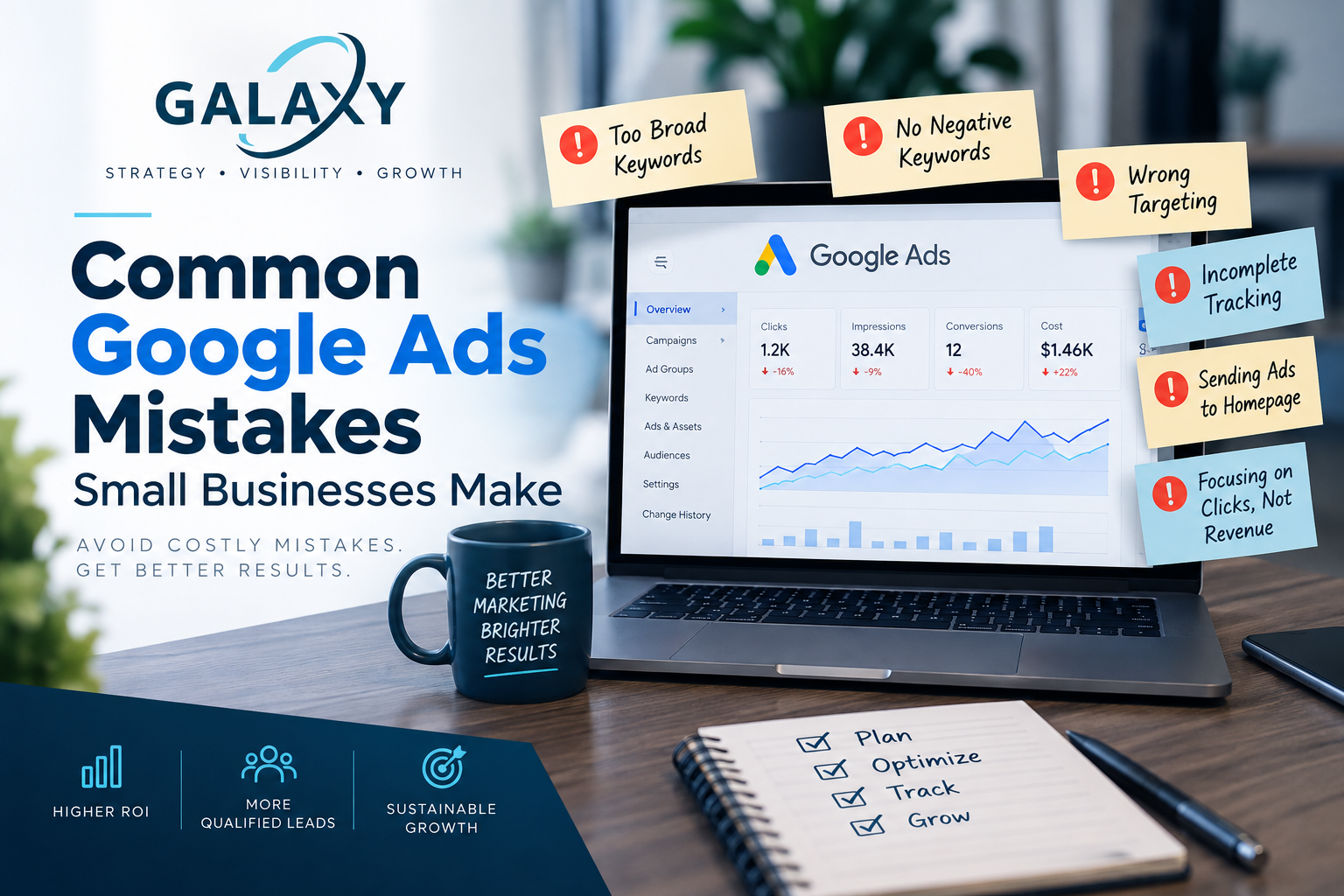
12 Common Google Ads Mistakes Small Businesses Make
Google Ads can put your business in front of customers at the exact moment they are searching—but small campaign mistakes can quickly turn an advertising budget into expensive clicks with little business impact.
From broad keywords and weak conversion tracking to poor landing pages and geographic targeting, this guide explains where Google Ads campaigns commonly go wrong and what small businesses should evaluate before simply increasing their budget.
Before Increasing Your Ad Budget, Ask:
- Are we targeting the right searches?
- Are we excluding irrelevant traffic?
- Are ads reaching the right locations?
- Are we measuring real conversions?
- Are those conversions qualified?
- Does the landing page match the search?
- Can we connect ad spend to actual sales?
WHY GOOGLE ADS CAMPAIGNS UNDERPERFORM
Google Ads Isn’t Just About Getting More Clicks
One of the biggest misconceptions about Google Ads is that success begins and ends with traffic. A campaign receives impressions, people click the ads, the website receives more visitors, and therefore the advertising must be working.
But traffic is only one part of the equation. A successful paid search campaign should help connect the right searcher with the right offer, in the right market, at a cost that makes sense for the business.
That requires more than turning on a campaign and choosing a daily budget. Keyword intent, search terms, geographic settings, advertisements, landing pages, conversion tracking, lead quality, customer value, sales follow-up, and ongoing optimization can all influence whether Google Ads becomes a useful customer-acquisition channel or an expensive source of unqualified traffic.
At Galaxy Marketing Services, we approach Google Ads as part of a larger digital customer journey. Paid search should connect with your website, SEO strategy, analytics, conversion tracking and sales process rather than operating as an isolated advertising platform.
The real question isn’t “Are people clicking?”
It’s whether those clicks are becoming qualified opportunities and customers at a sustainable acquisition cost.
COMMON GOOGLE ADS MISTAKES
Where Small-Business Google Ads Campaigns Go Wrong
Running Google Ads Without a Clear Business Goal
A campaign should begin with a business objective—not simply a desire to “get more traffic.” Without a defined outcome, it becomes difficult to determine which campaigns, keywords, conversions, and metrics actually matter.
For a roofing contractor, the goal might be qualified estimate requests for roof replacement. A law firm may prioritize consultations for specific practice areas. An eCommerce company may care about profitable product sales. A B2B company may need qualified sales opportunities rather than every form submission.
Those are very different objectives, and the campaigns supporting them should also be different.
Targeting Keywords That Are Too Broad
Broad search themes can expose an advertisement to people whose intent differs significantly from what the business actually sells.
A contractor targeting a general term related to “roofing,” for example, may encounter searches from homeowners seeking repairs, DIY instructions, materials, jobs, salary information, training, commercial services or entirely different roofing products.
The problem is not simply the keyword itself. Match types, search behavior, campaign structure and negative keywords all influence which searches can trigger an advertisement.
Ignoring the Search Terms Triggering Your Ads
Keywords tell Google which searches you want to target. Search-term data shows what people actually searched before interacting with your advertisements.
That distinction is extremely important.
Search-term reviews can uncover irrelevant searches consuming budget, unexpected variations of valuable queries, new negative keywords, geographic modifiers, customer language and potential keyword opportunities.
A campaign that is never reviewed at this level can continue spending money on traffic that appears relevant in top-level reports but does not represent the customers the business wants.
Not Building and Maintaining Negative Keyword Lists
Negative keywords help prevent advertisements from appearing for search themes that do not fit the business.
Common exclusions may involve employment searches, DIY questions, free products, education, unrelated services, inappropriate locations or customer needs the company does not serve.
However, negative keywords should not simply be copied from a generic list. An exclusion that makes sense for one business could eliminate valuable searches for another.
Negative keyword management should evolve as the campaign produces real search data.
THE PAID SEARCH CONVERSION PATH
A Click Is Only the Beginning
Strong Google Ads performance depends on the entire path between customer intent and business revenue.
1. Search
A prospective customer expresses a need through Google.
2. Advertisement
Your message needs to match that intent and create a reason to click.
3. Landing Page
The destination should continue the same service, offer and message.
4. Conversion
The visitor calls, submits a form, books, purchases or takes another valuable action.
5. Qualification
The business determines whether the conversion represents a legitimate opportunity.
6. Sales Process
The lead receives appropriate follow-up and moves through the sales process.
7. Customer
A qualified opportunity becomes revenue for the business.
8. Optimization
Advertising decisions improve when campaign data can be connected to meaningful outcomes.
Search → Ad → Landing Page → Conversion → Qualified Lead → Sale → Revenue
Sending Every Advertisement to the Homepage
Your homepage may be the most important page on your website, but that does not automatically make it the best destination for every advertisement.
Someone searching specifically for commercial HVAC maintenance, estate planning, roof replacement or a particular software solution should not have to navigate a general homepage to determine whether the business provides what they need.
The stronger the relationship between the search, advertisement and destination page, the easier it becomes for a visitor to understand the offer and take the next step.
Dedicated service pages or landing pages can also make it easier to present relevant proof, answer objections, measure conversions and test different offers.
Using Poor Geographic Targeting
Location settings can quietly waste a significant portion of a local business’s advertising budget.
A company may serve only a group of cities in Metro Detroit but run a campaign across an unnecessarily broad region. Another business may target an entire state even though most customers come from a relatively small service radius.
Geography should also reflect economics. A service area may technically include a distant city, but that does not mean every lead from that location is equally valuable or operationally practical.
Campaign performance should therefore be evaluated by city, region and other available location data—not simply at the account level.
Tracking the Wrong Conversions—or No Conversions at All
Google Ads cannot understand which clicks create business value if meaningful customer actions are not measured correctly.
For many small businesses, important conversions include contact forms, telephone calls, consultation requests, appointments, quote requests, purchases or other actions closely connected to revenue.
Problems arise when tracking is missing, duplicated or focused on low-value actions. A page view, button click or short website visit may provide useful analytical information, but it should not necessarily carry the same optimization value as a qualified consultation request.
Tracking should also be tested. A conversion tag existing inside an account does not automatically mean it fires correctly or measures what the business thinks it measures.
Treating Every Conversion as a Qualified Lead
Twenty form submissions are not necessarily twenty valuable sales opportunities.
Some inquiries may involve the wrong service, location, budget or customer type. Others may be spam, job seekers, vendors or existing customers. Looking only at conversion volume can therefore produce a misleading picture of performance.
This becomes particularly important when automated bidding strategies are given conversion data. The quality of the signals being measured can influence how campaigns optimize.
Whenever possible, advertising data should be evaluated alongside CRM and sales information so the business can understand which campaigns are producing qualified opportunities—not simply actions.
UNDERSTANDING ADVERTISING COST
Why Google Ads Can Feel So Expensive for Small Businesses
When Google Ads becomes expensive, cost per click often receives most of the attention. But a high CPC does not automatically make a campaign unprofitable, and a low CPC does not automatically make a campaign successful.
What ultimately matters is the relationship between advertising cost, conversion rate, lead quality, close rate and customer value.
Click Cost
How much does it cost to bring a relevant prospective customer to the website?
Conversion Rate
What percentage of those visitors complete a meaningful business action?
Lead Quality
How many conversions actually represent customers the business wants?
Customer Value
How much revenue or profit can a successfully acquired customer create?
Consider two campaigns. One generates inexpensive clicks but almost no qualified inquiries. Another pays more per click but consistently attracts customers looking for a high-value service. Judging those campaigns on CPC alone could lead to the wrong decision.
The objective is not necessarily to obtain the cheapest traffic. It is to build a sustainable path from advertising investment to profitable customer acquisition.
Spreading a Small Budget Across Too Many Campaigns
Small businesses often want to advertise every service, every location and every potential customer segment immediately.
The result can be an account with many campaigns competing for a limited budget. Individual campaigns may receive too little activity to generate useful data, while the business struggles to determine which opportunities deserve additional investment.
Prioritization is especially important when budgets are constrained.
Instead of treating every service equally, businesses can identify which services have stronger margins, greater customer value, higher demand, better close rates or greater strategic importance.
Relying Too Heavily on Automated Recommendations
Google Ads includes extensive automation and recommendations that can help advertisers identify opportunities and manage increasingly complex campaigns.
Automation can be useful—but a platform recommendation does not know every detail about your margins, staffing, sales process, customer quality, operational capacity or broader marketing strategy.
A recommendation to expand targeting, change bidding or increase a budget should therefore be evaluated against the business objective rather than accepted simply because the platform suggests it.
Automation works best when it receives meaningful data and operates within a strategy developed around real business priorities.
Making Too Many Changes Before Enough Data Exists
Google Ads gives advertisers access to enormous amounts of data, which can create pressure to constantly change campaigns.
A keyword has not converted this week, so it gets paused. An ad has a lower click-through rate, so it is replaced. A campaign has several slow days, so the budget moves elsewhere.
Some adjustments are necessary quickly—especially when tracking is broken or clearly irrelevant traffic is consuming budget. Other decisions require enough data to distinguish a meaningful trend from ordinary variation.
Frequent major changes can make performance more difficult to evaluate because the conditions being measured never remain stable for long.
Looking at Clicks Instead of Business Results
Clicks, impressions and click-through rate are useful campaign metrics, but they are not the final objective for most small businesses.
A business cannot pay employees with impressions. A contractor does not grow because an advertisement generated a high CTR. A professional-services firm does not acquire a new client simply because a form was submitted.
Advertising becomes more valuable when campaign performance can be connected to what happens after the click.
That may include qualified leads, booked appointments, estimates, sales opportunities, purchases, customer acquisition cost, revenue and return on advertising spend.
BUILDING A BETTER CAMPAIGN
What Should a Healthy Small-Business Google Ads Account Look Like?
There is no single campaign structure that works for every business, but strong accounts generally have a clear connection between advertising strategy and business strategy.
Clear Campaign Priorities
Campaigns focus on the services, products, customers and geographic markets that matter most.
Intent-Based Keywords
Keywords reflect how prospective customers search when they are looking for relevant solutions.
Relevant Advertisements
Ad messaging clearly communicates the service, value proposition and next step.
Aligned Landing Pages
Visitors arrive on pages that directly address the search and advertisement that brought them there.
Accurate Conversion Tracking
Calls, forms, bookings, purchases and other important actions are measured correctly.
Search-Term Management
Actual searches are reviewed to reduce irrelevant traffic and identify opportunities.
Lead-Quality Feedback
Advertising decisions incorporate what the sales team learns about the people converting.
Business-Level Reporting
Where possible, marketing data connects to qualified opportunities, customers, revenue and acquisition cost.
ACCOUNT STRATEGY
Should You Fix Your Existing Google Ads Campaign or Start Over?
Poor performance does not automatically mean an entire Google Ads account needs to be rebuilt. Existing campaigns may contain valuable historical data, keyword insights, conversion information and successful components worth preserving.
Optimization May Be Enough When:
- The basic account structure is logical
- Tracking can be repaired
- Strong campaigns already exist
- Search-term waste can be reduced
- Landing pages can be improved
- Budgets need better prioritization
- Campaign goals remain relevant
A Larger Restructure May Make Sense When:
- Services and keywords are mixed together without strategy
- Targeting no longer reflects the business
- Conversion data is unreliable
- Campaigns cannot be evaluated independently
- The company has significantly changed its offers or geography
- Years of incremental changes have made the account difficult to manage
An audit should identify what is working before changes are made. Rebuilding everything simply for the sake of having a “new” account can discard useful information just as easily as leaving a poorly structured campaign untouched can preserve unnecessary problems.
PAID + ORGANIC SEARCH
Google Ads and SEO Should Inform Each Other
Google Ads and SEO are different marketing channels, but businesses can learn more when paid and organic search strategies are evaluated together.
Paid search can provide insight into the terminology prospective customers use, which search themes produce conversions, how demand differs by location, which services receive stronger engagement and which landing pages convert traffic more effectively.
Those observations can help inform SEO and content strategy. At the same time, stronger organic service pages, local pages, technical performance and website usability can improve the destinations used by paid campaigns.
For many businesses, the strongest search strategy is not a choice between SEO and Google Ads. It is understanding the role each channel plays and using their data together to improve the overall customer-acquisition system.
CLIENT RESULTS
Why Campaign Optimization Matters
Sterling Construction & Roofing
Paid cost per lead reduced from $78 to $28.
Galaxy’s work combined paid advertising optimization with broader digital strategy, including targeting, conversion measurement and website coordination.
The objective was not simply to increase traffic. It was to make the advertising budget more effective at generating useful business opportunities.
Optimization Is Bigger Than One Metric
Reducing wasted traffic, improving targeting, strengthening conversion measurement and coordinating advertising with the website can change the economics of a campaign without simply chasing more clicks.
Explore more examples of Galaxy’s work through our client results and case studies.
Results vary by business, industry, market, competition, budget, website, offer, sales process and other factors. Past performance does not guarantee future results.
GALAXY MARKETING SERVICES
How Galaxy Approaches Google Ads Management
We don’t view Google Ads as an isolated dashboard. Campaigns exist inside a larger marketing, website, analytics and sales ecosystem.
Understand the Business
We start with services, products, margins, customers, geography, sales process and growth priorities.
Build Around Intent
Campaigns and keywords are structured around what prospective customers are actually trying to accomplish.
Measure Meaningful Actions
Tracking focuses on calls, forms, appointments, purchases and other business-relevant conversions.
Optimize With Context
Search terms, cost and conversions are considered alongside lead quality and business feedback.
METRO DETROIT + NATIONWIDE
Google Ads Management for Metro Detroit Businesses
Galaxy Marketing Services is a Detroit-area marketing and technology agency helping businesses improve how they use paid search, SEO, websites, analytics and digital technology to generate growth.
We work with businesses throughout Detroit, Royal Oak, Ferndale, Birmingham, Troy, Livonia, Southfield, Novi, Farmington Hills and communities across Southeast Michigan, while also supporting regional and nationwide campaigns.
Whether a business serves customers within a few miles or across multiple states, Google Ads strategy should reflect its actual market rather than relying on a generic campaign structure.
FREQUENTLY ASKED QUESTIONS
Google Ads Mistakes FAQ
Why is my Google Ads campaign getting clicks but no leads?
A campaign can generate clicks without leads when the searches are poorly aligned with the business, advertisements attract the wrong audience, landing pages do not match customer intent, conversion paths are weak or tracking is incomplete. Review search terms, geography, landing pages and conversion tracking before assuming the problem is simply insufficient budget.
Why is Google Ads spending money on irrelevant searches?
Keyword match behavior, broad targeting and incomplete negative keyword lists can cause advertisements to appear for searches that do not fit the business. Regular search-term reviews help identify those searches and determine where exclusions or campaign changes may be needed.
Should small businesses use broad match keywords?
Broad match can be useful in the right account, but it should not be treated as automatically appropriate for every small business. Available conversion data, bidding strategy, negative keywords, search volume, budget and the range of possible customer intent should all be considered before deciding how broadly to target searches.
How do I know if Google Ads is wasting money?
Look beyond total clicks. Review actual search terms, locations, conversion tracking, cost per conversion, lead quality and eventual sales outcomes. Spending may be inefficient when significant budget goes toward irrelevant searches, poor markets, low-value conversions or leads that consistently fail to become qualified opportunities.
Should Google Ads send traffic to my homepage?
Sometimes, but not automatically. The best destination is usually the page that most closely matches what the customer searched for and what the advertisement promised. Service-specific or campaign-specific pages can provide stronger message alignment and clearer conversion paths.
How often should Google Ads campaigns be optimized?
Accounts should be monitored regularly, but optimization does not mean making constant major changes. Search volume, budget, conversion volume, business seasonality and the significance of the issue should determine how quickly a decision is made. Some problems require immediate correction, while other trends need more data.
What is the most important Google Ads metric?
There is no single metric that explains campaign performance. Click-through rate, cost per click, conversions and cost per conversion are useful, but businesses should ultimately evaluate qualified leads, customers, acquisition cost, revenue and return on advertising investment whenever those outcomes can be measured.
Can Galaxy review an existing Google Ads account?
Yes. Galaxy Marketing Services can review existing campaign structure, keywords, search terms, negative keywords, geographic targeting, conversion tracking, landing pages, budgets and other areas that may be affecting paid search performance.
Not Sure Where Your Google Ads Budget Is Going?
Galaxy can review your digital marketing, Google Ads campaigns, website, search visibility and conversion paths to identify opportunities, technical issues and areas where your marketing may be working harder than it needs to.
Start with a free marketing audit and find out where the biggest opportunities may exist.