
Google Ads • Paid Search • Marketing Analytics
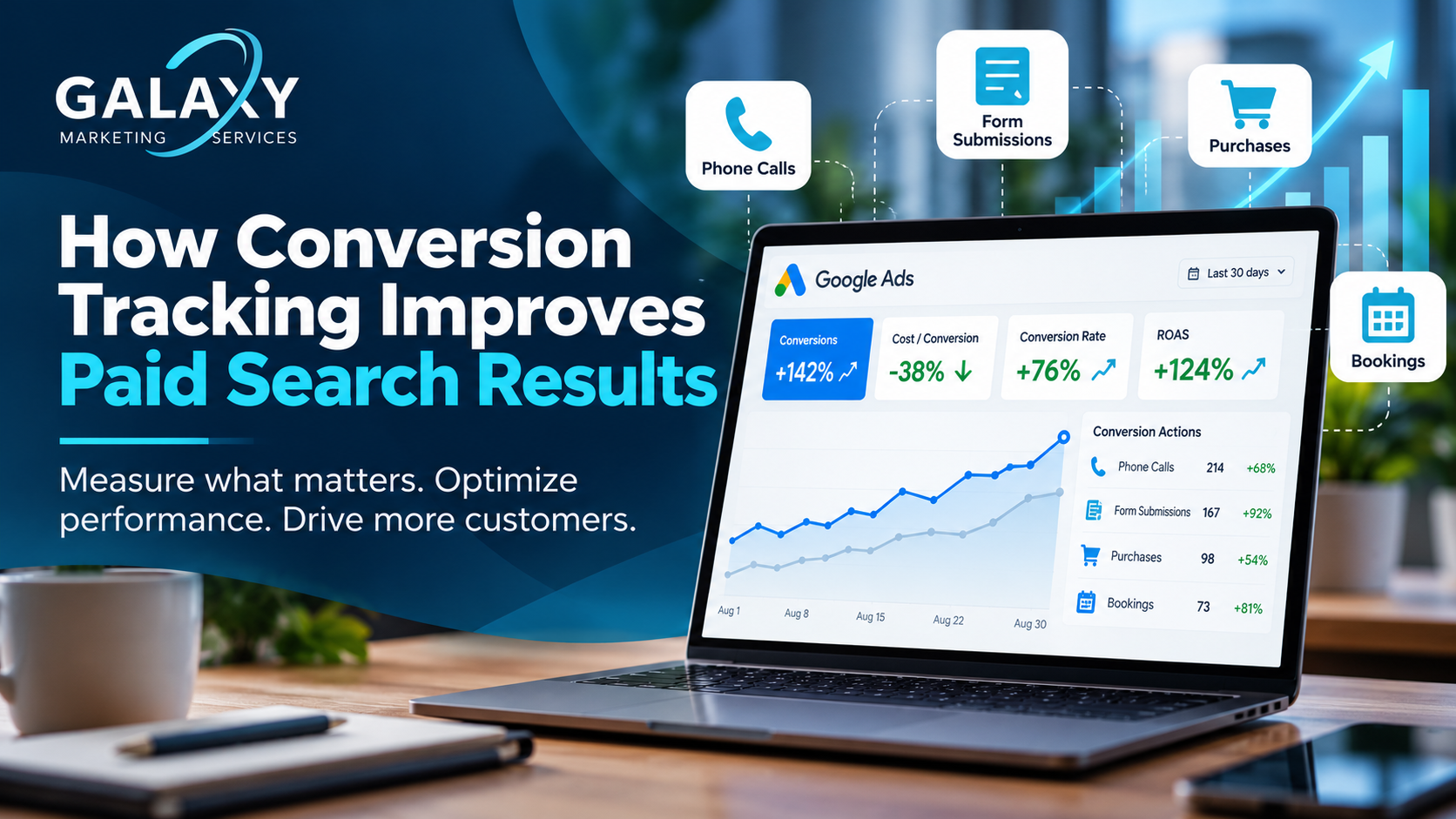
How Conversion Tracking Improves Paid Search Results
Discover how accurate conversion tracking helps businesses measure Google Ads performance, improve lead quality, optimize campaign spending, and make smarter marketing decisions.
The Foundation of Effective Paid Advertising
Why Conversion Tracking Matters for Google Ads Success
Running Google Ads without reliable conversion tracking is like investing in a marketing campaign without knowing whether it generates customers. You may understand how many people see or click your advertisements, but clicks alone do not explain whether your advertising is producing meaningful business results.
For businesses investing in paid search, the most important questions go beyond traffic. Which campaigns generate qualified inquiries? Which keywords lead to booked appointments or purchases? How much does it cost to acquire a customer? And which advertising investments contribute to revenue?
Conversion tracking connects advertising activity to measurable customer actions. It provides the information needed to evaluate performance, improve campaign targeting, guide automated bidding, and make better decisions about marketing budgets.
At Galaxy Marketing Services, we approach Google Ads management as more than keyword targeting and ad creation. Effective paid search requires a connected measurement strategy that links advertising, websites, customer inquiries, analytics, and business outcomes.
Quick Answer: Conversion tracking improves paid search results by identifying which advertisements, keywords, and campaigns produce valuable actions such as phone calls, form submissions, purchases, and qualified leads. This data supports campaign optimization, more informed bidding, better budget allocation, and more accurate performance reporting. The quality of the results depends on accurate tracking configuration and meaningful conversion definitions.
What Is Conversion Tracking in Paid Search?
Conversion tracking is the process of measuring valuable actions that people take after interacting with an advertisement. In Google Ads, these actions are recorded as conversions when they meet the configured conversion action and attribution requirements.
A conversion does not always mean an immediate purchase. The definition depends on the business model, customer journey, and goals of the campaign.
Lead Generation Conversions
- Contact form submissions
- Qualified phone calls
- Consultation requests
- Appointment bookings
- Estimate or quote requests
- CRM-qualified leads
eCommerce Conversions
- Completed purchases
- Transactions and revenue
- Subscription registrations
- Trial sign-ups
- Product inquiries
- Other meaningful buying actions
For example, a plumbing company may measure calls and service requests, while a catering company may prioritize event inquiries and booked consultations. A software company may measure demo requests and qualified sales opportunities.
The key is to identify actions that represent genuine business value instead of treating every website interaction as an equally important conversion.
7 Ways Conversion Tracking Improves Paid Search Performance
1. Identify High-Performing Keywords
Conversion data reveals which search terms and keywords are associated with meaningful business actions. A keyword generating fewer clicks may be more valuable than one generating high traffic but few qualified inquiries.
This helps advertisers evaluate search intent, refine keyword targeting, review search terms, and prioritize the queries that align with business objectives.
2. Reduce Wasted Advertising Spend
When advertisers understand which campaigns and search terms contribute to conversions, they can identify opportunities to reduce spending on lower-value traffic.
Conversion data supports decisions about negative keywords, geographic targeting, campaign structure, bidding strategies, and landing page improvements. It does not automatically eliminate wasted spend, but it makes inefficiencies easier to identify.
3. Improve Automated Bidding
Google Ads Smart Bidding strategies use conversion and conversion-value signals to optimize bids toward selected campaign objectives.
Strategies such as Maximize Conversions, Target CPA, Maximize Conversion Value, and Target ROAS depend on suitable conversion measurement and campaign settings.
If the system receives inaccurate or low-quality conversion signals, bidding may optimize toward actions that do not reflect real business value.
4. Measure Cost Per Lead
Conversion tracking makes it possible to calculate how much advertising spend is associated with each recorded lead or other conversion.
Cost per lead helps businesses compare campaign efficiency, but it should be considered alongside lead quality, conversion rate, customer acquisition cost, and revenue.
5. Improve Landing Page Performance
Conversion measurement helps reveal whether visitors are taking the intended actions after clicking an advertisement.
When combined with website analytics and usability testing, this information can guide improvements to page messaging, mobile usability, contact forms, calls to action, page speed, and the overall customer experience.
6. Improve Budget Allocation
Reliable conversion reporting makes it easier to compare performance across campaigns, locations, services, and audience segments.
Advertisers can use this information to determine where additional investment may be justified and where campaign changes are needed before increasing spending.
7. Connect Marketing Results to Revenue
For businesses with longer sales cycles, a form submission may be only the beginning of the customer journey. CRM integration and offline conversion imports can help connect advertising activity with later milestones such as qualified leads, sales opportunities, and closed deals.
This provides a more complete view of campaign value and can support bidding strategies that prioritize higher-quality outcomes rather than simply increasing the volume of initial inquiries.
Marketing Technology & Measurement
The Technology Behind Accurate Conversion Tracking
Effective measurement requires more than installing a tracking tag. It depends on how advertising platforms, websites, analytics systems, consent settings, and customer data work together.
Google Ads Conversion Actions
Define and measure valuable outcomes directly in Google Ads, including website conversions, phone calls, and imported offline events.
Google Analytics 4
Analyze website engagement, key events, traffic acquisition, and customer behavior across supported digital interactions.
Google Tag Manager
Manage supported marketing and analytics tags through a structured implementation and testing process.
CRM & Offline Conversion Data
Connect lead and sales milestones with advertising data through supported CRM integrations and conversion import workflows.
Galaxy also supports workflow automation and API integrations, helping businesses connect marketing platforms with operational systems when the project requires more advanced lead management and reporting.
Understanding the Metrics That Matter Most
Conversion tracking creates useful performance data, but the metrics need to be interpreted correctly. A campaign that produces inexpensive leads is not necessarily more profitable than one that generates fewer, higher-quality customers.
| Metric | What It Measures | Why It Matters |
|---|---|---|
| Conversion Rate | Conversions divided by eligible ad interactions | Shows how frequently interactions lead to tracked actions |
| Cost Per Conversion | Advertising cost divided by recorded conversions | Helps evaluate acquisition efficiency |
| Cost Per Qualified Lead | Advertising cost divided by qualified leads | Accounts for lead quality rather than volume alone |
| Conversion Value | Value assigned to recorded conversions | Helps compare the business importance of outcomes |
| ROAS | Attributed conversion value divided by advertising cost | Measures attributed revenue or value relative to spend |
| Customer Acquisition Cost | Relevant acquisition costs divided by new customers | Connects marketing investment with actual customer acquisition |
Example: Why More Leads Do Not Always Mean Better Results
Consider two hypothetical paid search campaigns. Both spend $2,000, but their results differ.
| Performance Metric | Campaign A | Campaign B |
|---|---|---|
| Advertising Spend | $2,000 | $2,000 |
| Tracked Leads | 80 | 40 |
| Cost Per Lead | $25 | $50 |
| Qualified Leads | 12 | 24 |
| Cost Per Qualified Lead | $166.67 | $83.33 |
Campaign A generates twice as many leads at half the cost per lead. However, Campaign B produces twice as many qualified leads for the same advertising spend.
Without qualification data, Campaign A might appear to be the stronger performer. Connecting CRM outcomes with advertising reports reveals a different picture.
This example is illustrative, not a Galaxy client case study. Actual campaign performance depends on industry, competition, targeting, lead quality, sales processes, and measurement accuracy.
Primary vs. Secondary Conversions: Why the Difference Matters
Google Ads allows advertisers to distinguish between primary and secondary conversion actions. Understanding the difference helps prevent campaigns from optimizing toward actions that do not represent the main business objective.
Primary Conversions
Primary conversions are generally used for bidding optimization and reported in the Conversions column when included in the campaign’s selected conversion goals.
Examples include completed purchases, qualified service inquiries, booked consultations, and other high-value actions.
Secondary Conversions
Secondary conversions are generally observed for reporting purposes without directly guiding bidding under standard goal configurations.
Examples might include newsletter sign-ups, brochure downloads, or other supporting interactions. Campaign-specific goal settings can affect how conversion actions are used.
For example, a contractor might track both contact-page views and submitted estimate requests. However, optimizing primarily toward page views could reward campaigns that generate browsing activity without producing qualified inquiries.
Choosing meaningful conversion goals is essential because automated bidding responds to the signals advertisers provide.
How to Set Up Conversion Tracking for Google Ads
A successful implementation starts with business goals and works backward toward the events and systems needed to measure them. The exact configuration depends on the website platform, advertising account, consent requirements, and customer journey.
Step 1: Define Business Outcomes
Identify the actions that indicate meaningful progress toward a sale. Separate initial engagement events from qualified leads, purchases, and completed transactions.
Step 2: Audit Existing Tracking
Review Google Ads conversion actions, Google Analytics 4 events, Google Tag Manager containers, existing website tags, and CRM data sources. Identify missing events, duplicate tracking, and inconsistent attribution settings.
Step 3: Implement Conversion Events
Configure supported Google Ads tags, GA4 events, or conversion imports. Use appropriate event triggers, transaction identifiers, conversion values, and counting settings.
Step 4: Validate the Data
Test conversion events with appropriate debugging tools. Verify that successful actions register correctly, duplicate conversions are avoided, and reported values match the intended measurement setup.
Step 5: Connect Lead Quality
Where appropriate, connect CRM outcomes or offline conversion imports to distinguish qualified opportunities from unqualified inquiries. Apply relevant privacy, consent, and data-handling requirements.
Step 6: Optimize and Monitor
Use reliable conversion reporting to evaluate bidding strategies, landing pages, keywords, budgets, and campaign structure. Continue monitoring data quality as the website and advertising account change.
For implementation guidance, review Google’s official conversion tracking documentation and the Google Tag Manager developer documentation.
Common Conversion Tracking Mistakes That Hurt Campaign Performance
Even when conversion tracking is installed, configuration problems can produce misleading performance reports and influence automated bidding in undesirable ways.
- Tracking page visits as primary conversions: Optimizing toward visits instead of valuable customer actions.
- Duplicate conversion events: Counting the same action more than intended through overlapping tags or imported events.
- Missing phone call tracking: Overlooking an important source of leads for service-based businesses.
- Incorrect conversion values: Assigning values that do not reasonably reflect business outcomes.
- Ignoring lead quality: Optimizing for inquiry volume without considering qualified opportunities or sales.
- Unverified form tracking: Recording button clicks rather than confirmed successful submissions.
- Inconsistent attribution settings: Comparing reports without accounting for differences in attribution models, conversion windows, or reporting scope.
- Consent and privacy gaps: Implementing tracking without appropriate consent handling or applicable privacy safeguards.
Routine measurement audits can identify these issues before they distort reporting or influence major budget decisions.
Conversion Tracking Strategies by Industry
Different industries need different conversion goals because their customer journeys and sales processes vary.
Home Services & Contractors
Roofing, HVAC, plumbing, and other contractors may prioritize qualified phone calls, estimate requests, booked appointments, and completed jobs.
Healthcare Practices
Medical practices may focus on appointment requests, qualified calls, and scheduling actions, with careful attention to privacy and restrictions on sensitive health information.
Restaurants & Hospitality
Restaurants and catering businesses may measure online orders, reservation completions, event inquiries, and catering consultations.
B2B & Professional Services
B2B organizations may prioritize qualified demo requests, sales meetings, proposals, opportunities, and closed revenue rather than initial form submissions alone.
Explore the industries Galaxy Marketing Services supports to learn how digital marketing strategies can be adapted to different customer journeys and business objectives.
How Galaxy Marketing Services Approaches Paid Search Measurement
Paid search performance improves when campaign strategy, conversion measurement, and business operations are aligned. Galaxy combines digital marketing experience with website development, analytics, CRM integrations, and automation to help organizations build a more complete understanding of their advertising investments.
Our approach begins by evaluating existing conversion goals, advertising accounts, analytics configurations, website experiences, and lead-handling processes. From there, we identify practical improvements based on the business’s objectives and available systems.
Measurement & Analytics
Review conversion events, Google Ads reporting, GA4 configuration, attribution considerations, and measurement quality.
Campaign Optimization
Evaluate keyword intent, campaign structure, bidding strategies, landing pages, and budget allocation using relevant performance data.
Lead Management Integration
Where supported, connect advertising inquiries with CRM workflows, qualification stages, customer follow-up, and sales reporting.
Continuous Improvement
Use performance trends and business feedback to refine campaign strategy, improve tracking accuracy, and prioritize future opportunities.
Serving Metro Detroit and Businesses Nationwide
Galaxy Marketing Services is based in the Detroit metropolitan area and works with businesses throughout Southeast Michigan, including Detroit, Royal Oak, Troy, Birmingham, Livonia, and surrounding communities. We also support businesses across the United States through remote digital marketing, website development, analytics, and technology engagements.
Whether your business needs a Google Ads tracking audit, more effective lead measurement, or a broader digital marketing strategy, our team can help evaluate opportunities for improvement.
Frequently Asked Questions About Conversion Tracking
What is conversion tracking in Google Ads?
Conversion tracking in Google Ads measures valuable actions associated with ad interactions, such as purchases, calls, form submissions, and qualified leads. It helps advertisers understand which campaigns contribute to business goals.
How does conversion tracking improve Google Ads performance?
Conversion tracking identifies campaigns and keywords associated with valuable outcomes. This information supports better reporting, budget decisions, landing page improvements, and conversion-focused automated bidding.
What conversions should a service business track?
Service businesses commonly track qualified calls, successful contact form submissions, appointment bookings, quote requests, and CRM-qualified leads. The most important conversions should reflect meaningful progress toward acquiring a customer.
Is Google Analytics 4 enough for Google Ads conversion tracking?
GA4 can provide useful website and event measurement, and supported GA4 key events can be imported into Google Ads. However, some businesses benefit from Google Ads-native conversion actions, call measurement, enhanced conversions, or offline conversion imports. The right setup depends on measurement goals and technical requirements.
What is the difference between a lead and a qualified lead?
A lead is an inquiry or contact generated through marketing. A qualified lead meets defined business criteria, such as service need, location, budget, or purchase intent. Tracking qualification helps advertisers evaluate lead quality instead of relying only on inquiry volume.
Can conversion tracking help reduce Google Ads costs?
Conversion tracking can help identify inefficient campaigns, low-value search traffic, and opportunities to improve targeting or bidding. While it does not guarantee lower advertising costs, it provides data that can support more efficient spending and better acquisition decisions.
Are Your Google Ads Generating the Right Results?
Clicks are only part of the story. Galaxy Marketing Services helps businesses evaluate conversion tracking, improve paid search measurement, and connect advertising performance with meaningful business outcomes.
Let’s identify opportunities to strengthen your Google Ads strategy, lead tracking, and digital marketing performance.