
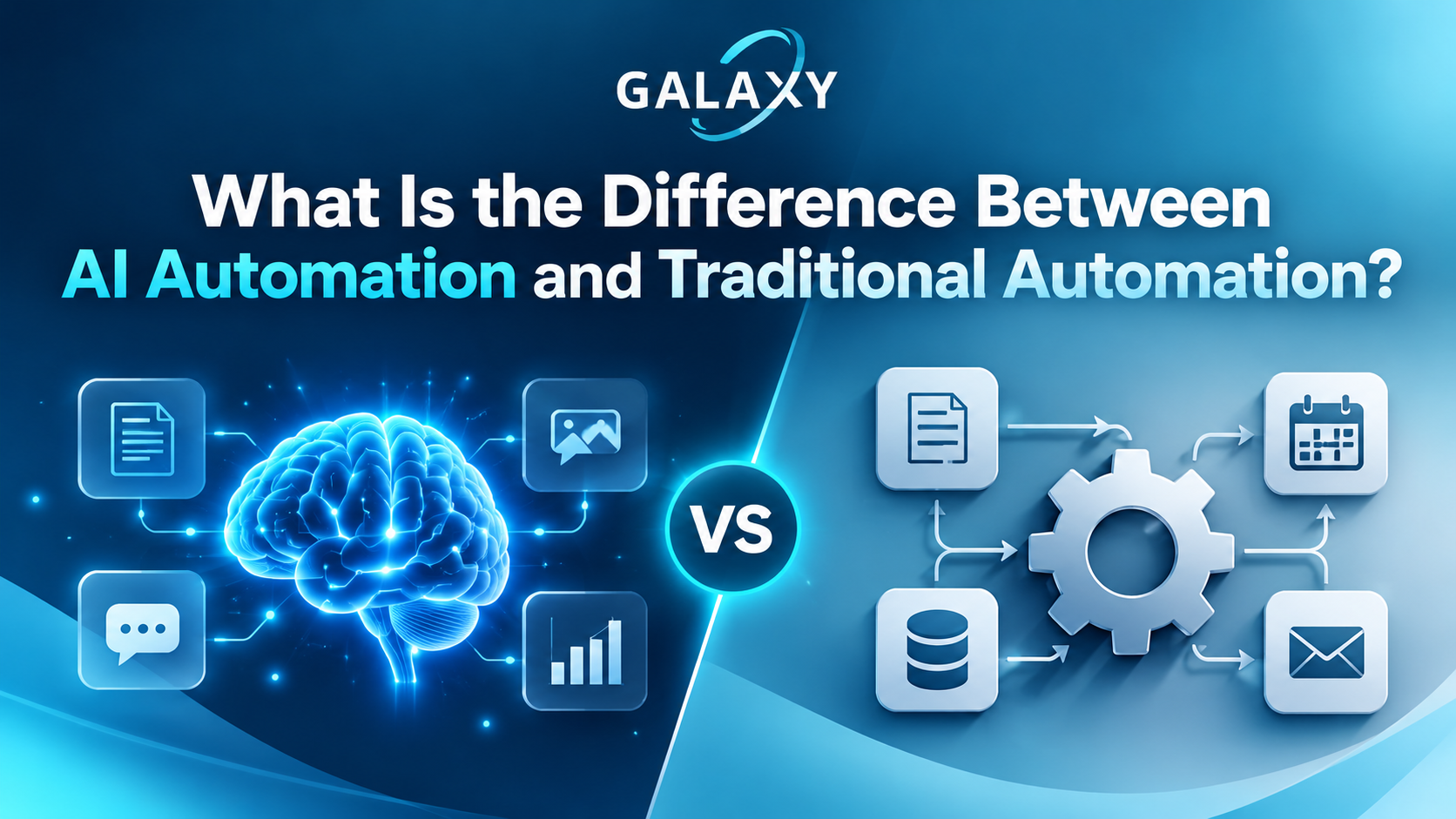
What Is the Difference Between AI Automation and Traditional Automation?
Automation is changing how businesses operate, but not every automated system uses artificial intelligence. Understanding the difference between AI automation and traditional automation can help your business reduce repetitive work, improve efficiency, control costs, and make smarter technology investments.
In this guide, Galaxy Marketing Services explains how both approaches work, where they deliver the most value, and how to determine which automation strategy makes sense for your organization.
Explore AI Automation SolutionsAI Automation vs. Traditional Automation: The Short Answer
The primary difference between AI automation and traditional automation is how each system processes information and determines what to do next. Traditional automation follows predefined rules and workflows, while AI automation uses artificial intelligence to interpret information, recognize patterns, generate responses, and support decisions that are difficult to define using fixed rules alone.
Traditional automation is particularly effective when a business process is predictable. AI automation becomes useful when a process involves unstructured information, variable customer requests, document interpretation, or decisions requiring contextual understanding.
Importantly, AI automation does not eliminate the need for traditional automation. Many effective business systems combine both technologies, using AI for interpretation and rule-based workflows for dependable execution.
Example: A traditional automation system can automatically send a confirmation email when a customer submits a form. An AI-powered system can additionally interpret the customer’s message, identify the requested service, classify the lead, and prepare a personalized response before a predefined workflow routes it to the appropriate employee.
What Are Traditional Automation and AI Automation?
Both approaches reduce manual effort, but they solve different kinds of operational problems. Understanding their capabilities is the first step toward selecting the right technology.
Traditional Automation
Traditional automation uses predetermined instructions, triggers, conditions, and actions to complete repetitive tasks without requiring a person to perform each step.
These systems operate according to rules established during configuration. When a specified event occurs, the automation executes the corresponding action.
Common examples include scheduled email campaigns, invoice reminders, CRM updates, appointment confirmations, data transfers, and recurring reports.
Best suited for: Structured, repeatable processes with clearly defined conditions and outcomes.
AI Automation
AI automation incorporates artificial intelligence technologies such as machine learning, natural language processing, computer vision, or large language models into automated business processes.
Instead of relying exclusively on rigid instructions, these systems can interpret information, classify requests, extract details from documents, generate content, and recommend actions based on context.
Examples include AI-assisted customer support, intelligent lead qualification, document processing, automated content workflows, and AI-powered business reporting.
Best suited for: Processes involving variable inputs, unstructured information, or contextual interpretation.
Key Differences Between AI Automation and Traditional Automation
The following comparison highlights how these technologies differ across several important business considerations.
| Feature | Traditional Automation | AI Automation |
|---|---|---|
| Decision Process | Predefined rules and conditions | AI-assisted interpretation and decisions |
| Input Requirements | Works best with structured information | Can process structured and unstructured information |
| Flexibility | Changes generally require updated rules | Can handle greater variation within its capabilities |
| Predictability | Typically highly predictable | Outputs may vary and require validation |
| Implementation | Often simpler for clearly defined workflows | May require model selection, testing, and safeguards |
| Operating Costs | Usually driven by software and workflow usage | May include model, token, compute, and monitoring costs |
| Typical Applications | Notifications, scheduling, CRM updates | Lead analysis, document interpretation, AI assistants |
| Human Oversight | Needed for exceptions and system maintenance | Especially important for uncertain or high-impact decisions |
These are general distinctions. Actual capabilities depend on the tools, integrations, and safeguards used.
Six Real-World Examples of AI Automation vs. Traditional Automation
The differences become clearer when examining everyday business operations. Below are practical examples of how both technologies can support common workflows.
Lead Management
Traditional: Automatically creates a CRM contact whenever someone submits a website form.
AI-powered: Reviews the inquiry, identifies customer intent, categorizes the requested service, and recommends a lead priority.
Businesses can combine these functions to reduce administrative work while improving lead routing.
Customer Communication
Traditional: Sends a predetermined message after an appointment is scheduled.
AI-powered: Interprets a customer’s question and generates a relevant response using approved business information.
Human review and escalation remain important for complex or sensitive inquiries.
Marketing Operations
Traditional: Publishes scheduled posts or sends emails based on predefined triggers.
AI-powered: Analyzes campaign information, identifies content opportunities, and prepares personalized marketing recommendations.
Marketing teams can review AI-generated outputs before publication.
Document Processing
Traditional: Transfers values between systems when documents follow a consistent format.
AI-powered: Extracts relevant information from invoices, forms, contracts, and other documents with varying layouts.
Validation rules can catch missing information before records are updated.
Business Reporting
Traditional: Collects predefined metrics and distributes a scheduled dashboard.
AI-powered: Helps interpret performance changes, summarizes findings, and identifies potential areas for investigation.
AI explanations should be checked against the underlying data.
Appointment Scheduling
Traditional: Sends reminders and confirmations when bookings are created.
AI-powered: Interprets conversational scheduling requests and extracts details needed to initiate a booking workflow.
Availability checks and final booking actions should use authoritative scheduling systems.
How AI Automation Systems Actually Work
AI automation is not simply a chatbot connected to a business application. A reliable system typically combines artificial intelligence, workflow logic, business data, APIs, and monitoring.
AI Models & Reasoning
Language models and other AI technologies interpret incoming information, classify requests, generate responses, or produce structured outputs.
Workflow Orchestration
Automation platforms such as n8n, Make, and Zapier coordinate triggers, conditional logic, API calls, approvals, and actions across connected systems.
Business System Integrations
CRM platforms, analytics tools, email systems, databases, and other applications provide the operational information needed to complete tasks.
Validation & Human Oversight
Permission controls, data validation, logging, error handling, and approval steps help reduce mistakes and prevent unauthorized actions.
A practical example: An AI system can read a new customer inquiry and extract the service requested. A traditional workflow can then verify the required fields, create a CRM record, assign the lead, and notify the appropriate team member. This combination provides flexibility without sacrificing operational control.
What Are the Advantages of AI-Powered Automation?
AI automation can extend automation into processes that previously required significant human interpretation. However, its value depends on selecting the right business problems and implementing appropriate controls.
Less Repetitive Administrative Work
AI can assist with organizing inquiries, extracting document information, drafting responses, and preparing reports. Employees can spend less time handling repetitive information-processing tasks and more time on customer relationships and higher-value work.
More Flexible Customer Experiences
AI-powered systems can interpret requests written in different ways, making them useful for customer service, lead intake, and internal support. Responses can be tailored to the context of an inquiry rather than relying exclusively on a fixed message.
Faster Information Processing
Businesses can use AI to summarize documents, organize large collections of information, and highlight potential issues for review. This can accelerate workflows that would otherwise require substantial manual reading or classification.
Greater Operational Scalability
Well-designed automation can help organizations handle growing volumes of inquiries and routine work without increasing administrative effort at the same rate. Capacity still depends on system limits, oversight, and operating costs.
Is AI Automation Always Better Than Traditional Automation?
No. AI automation is not automatically the better choice. Traditional automation is often more reliable, predictable, and cost-effective for processes that follow clearly established rules.
Consider a business that needs to send an appointment reminder exactly 24 hours before a scheduled visit. A conventional scheduling workflow can complete this task consistently without introducing AI-generated decisions or additional model costs.
Adding artificial intelligence to this process would provide little additional value unless the business also needed to interpret conversational responses, classify appointment changes, or support more complicated customer interactions.
Important AI Automation Limitations
AI systems can produce inaccurate information, misunderstand instructions, or generate inconsistent outputs. They may also introduce additional costs, privacy considerations, integration complexity, and ongoing monitoring requirements.
Organizations should evaluate the sensitivity of their data, the consequences of errors, and the level of human oversight required before allowing an AI system to take consequential actions.
Our recommendation: Use traditional automation for deterministic tasks and AI automation when interpretation or flexibility creates measurable business value. Combine them when a workflow requires both.
How Much Does AI Automation Cost Compared to Traditional Automation?
The cost of automation depends on the complexity of the workflow, the software involved, the number of integrations, data requirements, security considerations, and the amount of customization required.
Traditional automation may be relatively inexpensive when businesses can use existing CRM features, scheduling tools, or established automation platforms. Costs increase when workflows require custom integrations, specialized development, or extensive maintenance.
AI automation introduces additional considerations, including AI model usage, data processing, prompt development, testing, monitoring, and human review. These expenses should be evaluated alongside the potential time savings and operational improvements.
Simple Automation Projects
Basic workflows such as notifications, form routing, CRM updates, and straightforward AI-assisted tasks may require relatively limited development.
The most important consideration is whether the workflow solves a clearly defined problem without unnecessary complexity.
Custom AI Automation Systems
Advanced implementations involving multiple integrations, document interpretation, AI agents, custom business logic, or specialized infrastructure typically require more extensive planning and development.
Ongoing operating costs and maintenance should be considered before deployment.
How to evaluate automation ROI: Estimate the time currently spent on a process, the cost of that time, the expected reduction in manual work, and the total cost of implementing and maintaining the automation. Include error rates and quality improvements rather than evaluating labor savings alone.
Businesses should also consider the cost of doing nothing. Delayed lead responses, repetitive administrative tasks, inconsistent data entry, and disconnected systems can create operational inefficiencies that grow as the organization expands.
How to Decide Which Automation Is Right for Your Business
The best automation strategy begins with your business processes rather than a specific software platform or AI model.
At Galaxy Marketing Services, we believe automation should be designed around measurable operational goals, existing technology, and practical implementation requirements.
A successful automation project should make the business easier to operate, not introduce unnecessary complexity.
Discuss Your Automation NeedsDocument processes that consume employee time, create bottlenecks, or require repeated manual data entry.
Determine whether each process follows predictable rules or requires interpretation of variable information.
Examine your CRM, website, scheduling, reporting, and communication platforms to identify available integrations.
Start with one measurable workflow, establish success criteria, and include appropriate review procedures.
Track time savings, accuracy, cost, reliability, and business outcomes before expanding automation.
Why Combining AI and Traditional Automation Often Works Best
Many businesses do not need to choose exclusively between AI automation and traditional automation. Combining both approaches can create a system that balances intelligence, flexibility, consistency, and control.
Consider a home service company receiving customer requests through its website.
A traditional workflow can detect a new form submission and collect the customer’s contact information. An AI model can then interpret the customer’s description, identify the likely service category, and summarize the request.
The workflow can validate the information, create or update a CRM record, notify the appropriate employee, and prepare a follow-up message for approval.
This architecture allows AI to perform interpretation while established automation rules handle system updates and other predictable actions.
Key takeaway: The strongest automation strategy is not necessarily the one that uses the most AI. It is the one that reliably improves business outcomes with the least unnecessary complexity.
How Small Businesses Can Use AI Automation
AI-powered automation can support organizations across many industries. The most valuable applications depend on the type of work performed and the information employees handle every day.
Home Service Companies
Plumbing, HVAC, roofing, and construction companies can use automation to organize incoming leads, classify service requests, streamline appointment coordination, and support customer follow-up.
Professional Services
Professional service organizations can automate inquiry intake, document organization, administrative routing, and internal knowledge retrieval while maintaining appropriate privacy and review controls.
Marketing & Creative Agencies
Agencies can connect AI with reporting, CRM platforms, content workflows, research processes, and campaign analysis to reduce repetitive production and administrative work.
Retail & E-Commerce
Retail businesses can use automation for order notifications, customer communication, product information management, and operational reporting. AI can assist with categorization, recommendations, and support inquiries.
How Do You Know Whether Automation Is Working?
Successful automation should produce measurable improvements. Businesses should establish a baseline before implementation and evaluate results after deployment.
Time Saved
Measure the reduction in employee time required to complete repetitive tasks, process inquiries, or prepare routine information.
Response Speed
Track how quickly customer inquiries are acknowledged, classified, and routed to the appropriate team.
Quality & Reliability
Monitor accuracy, exception rates, manual corrections, workflow completion, and the cost of operating each automated process.
These measurements help determine whether an automation project should be improved, expanded, or redesigned. A workflow that saves time but produces frequent errors may not deliver the expected return on investment.
AI Automation and Business Integration Solutions
Galaxy Marketing Services helps businesses connect marketing technology, operational systems, and automation tools to improve efficiency and support sustainable growth.
Our capabilities span digital marketing, analytics, CRM integrations, website development, workflow automation, and AI-assisted business processes.
Rather than approaching AI as a standalone solution, we focus on how automation fits within the technology a business already uses. This includes evaluating existing workflows, identifying integration opportunities, and determining where AI can provide meaningful value.
Whether an organization needs a straightforward CRM workflow or a more advanced AI-powered process, the objective remains the same: create dependable systems that reduce friction and support business growth.
AI Automation Consulting in Detroit and Southeast Michigan
Galaxy Marketing Services is based in Metro Detroit and works with businesses throughout Southeast Michigan, including Detroit, Royal Oak, Troy, Birmingham, Livonia, Ferndale, Southfield, Novi, and surrounding communities.
We help local organizations evaluate automation opportunities, connect existing business systems, and implement practical technology solutions that support their operational and marketing goals.
Our automation and digital technology services can also support businesses outside Michigan through remote consulting and implementation.
Schedule a ConsultationFrequently Asked Questions About AI Automation
What is the main difference between AI automation and traditional automation?
Traditional automation follows predefined rules to complete repetitive tasks. AI automation incorporates artificial intelligence to interpret information, recognize patterns, and support more flexible decision-making. Both can be combined within the same workflow.
Is AI automation better than traditional automation?
Not always. Traditional automation is generally better for predictable, rule-based processes. AI automation can be more useful when tasks require interpreting variable or unstructured information. The best choice depends on business requirements, cost, reliability, and risk.
What are examples of AI automation in business?
Examples include AI-assisted lead qualification, customer inquiry classification, intelligent document processing, content workflow support, internal knowledge assistants, and automated business reporting.
Can AI automation replace traditional automation?
AI can expand the range of tasks that businesses automate, but traditional workflows remain valuable for predictable execution. Many organizations benefit from using AI for interpretation and traditional automation for structured actions.
What is the difference between RPA and AI automation?
Robotic process automation, or RPA, typically automates repetitive interactions with software applications using predefined instructions. AI automation incorporates artificial intelligence to interpret information and handle more variable tasks. RPA and AI can also be integrated.
How much does AI automation cost for a small business?
Costs vary depending on workflow complexity, integrations, AI model usage, customization, and maintenance. Simple implementations may require relatively limited development, while advanced systems involving multiple applications and custom logic can require a larger investment.
Can small businesses benefit from AI automation?
Yes. Small businesses can use AI automation to assist with lead management, customer communication, document processing, reporting, and other repetitive activities. Starting with a clearly defined workflow is often the most practical approach.
What tools are commonly used for AI automation?
Common technologies include AI models from providers such as OpenAI, workflow platforms such as n8n, Make, and Zapier, CRM systems, databases, and application programming interfaces. The appropriate tools depend on the business and its existing technology infrastructure.
AI Automation vs. Traditional Automation: Which Should You Choose?
AI automation and traditional automation are not competing solutions that require businesses to select only one. They are complementary technologies designed to solve different problems.
Traditional automation provides dependable execution for structured, repetitive processes. AI automation extends those capabilities by helping systems interpret information, respond to variable inputs, and support more sophisticated workflows.
For many organizations, the best approach is to combine both technologies. AI can handle interpretation and information processing, while traditional automation manages predictable actions, integrations, and operational safeguards.
Businesses considering automation should begin by identifying repetitive work, defining measurable objectives, evaluating their existing technology, and selecting solutions based on practical business value.
With the right strategy, automation can help organizations improve efficiency, support employees, strengthen customer experiences, and create more scalable operations.
Ready to Explore AI Automation for Your Business?
Whether you’re looking to automate repetitive tasks, connect business applications, improve lead management, or explore AI-powered workflows, Galaxy Marketing Services can help you identify practical opportunities.
Schedule Your AI Automation Consultation